


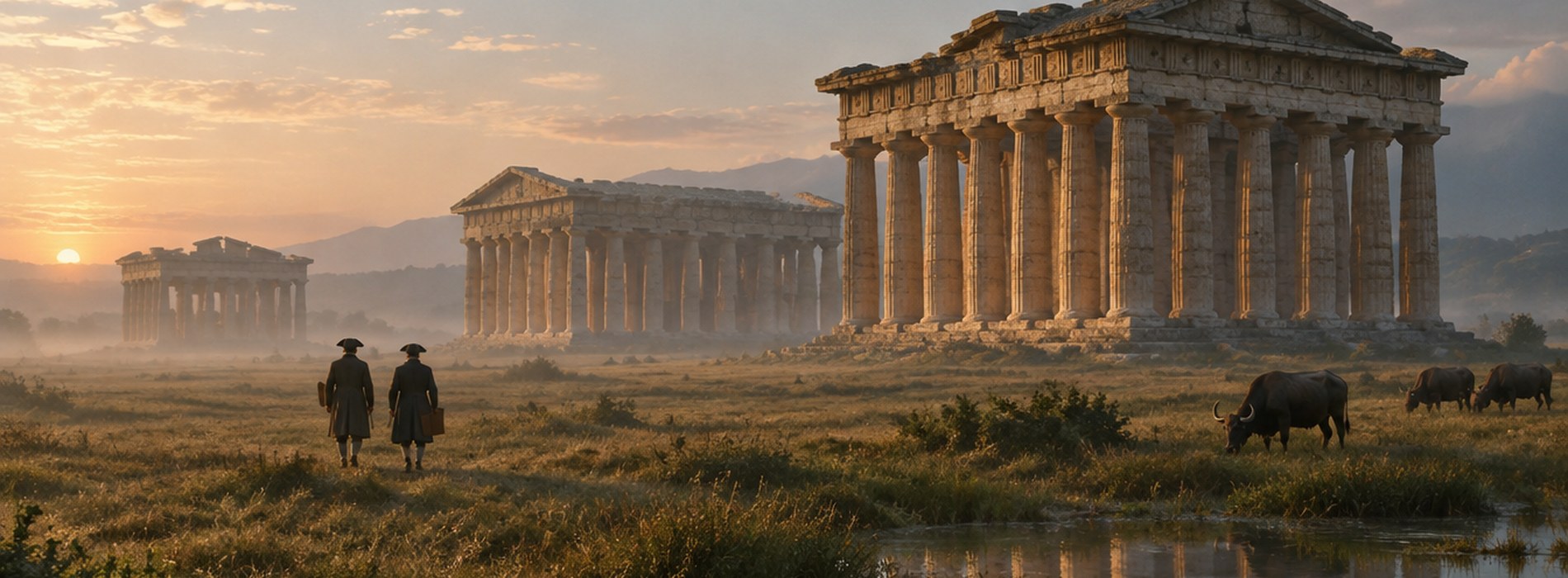
Paestum · The Doric temples
The pact with Kniep: they will live and travel together, he will only draw, and the outlines will belong to Goethe. On the deserted plain great oblong masses turn out to be temples: first dismay at the squat, crowded columns, then, in less than an hour, remembering the history of art, Goethe feels reconciled.
Naples, 23 March 1787
The terms of my engagement with Kniep are now settled, and it has commenced in a right practical way. We went together to Pæstum, where, and also on our journey thither and back, he showed the greatest industry with his pencil. He has taken some of the most glorious outlines possible. He seems to relish this moving but busy sort of life, which has called for a talent which he was scarcely conscious of. This comes of being resolute: but it is exactly here that his accurate and nice skill shows itself. He never stops to surround the paper on which he is about to draw with the usual rectangular lines; however, he seems to take as much pleasure in cutting points to his pencil, which is of the best English lead, as in drawing itself. Thus his outlines are just what one would wish them to be.
Now we have come to the following arrangement:–From this day forward, we are to live and travel together; while he is to have nothing to trouble himself about but drawing, as he has done for the last few days.
All the sketches are to be mine; but in order to a further profit, after our return, from our connexion, he is to finish for a certain sum a number of them, which I am to select; and then, remuneration for the others is to be settled according to the dexterity he evinces in them, and the importance of the views taken, and other considerations. This arrangement has made me quite happy, and now at last I can give you an account of our journey.
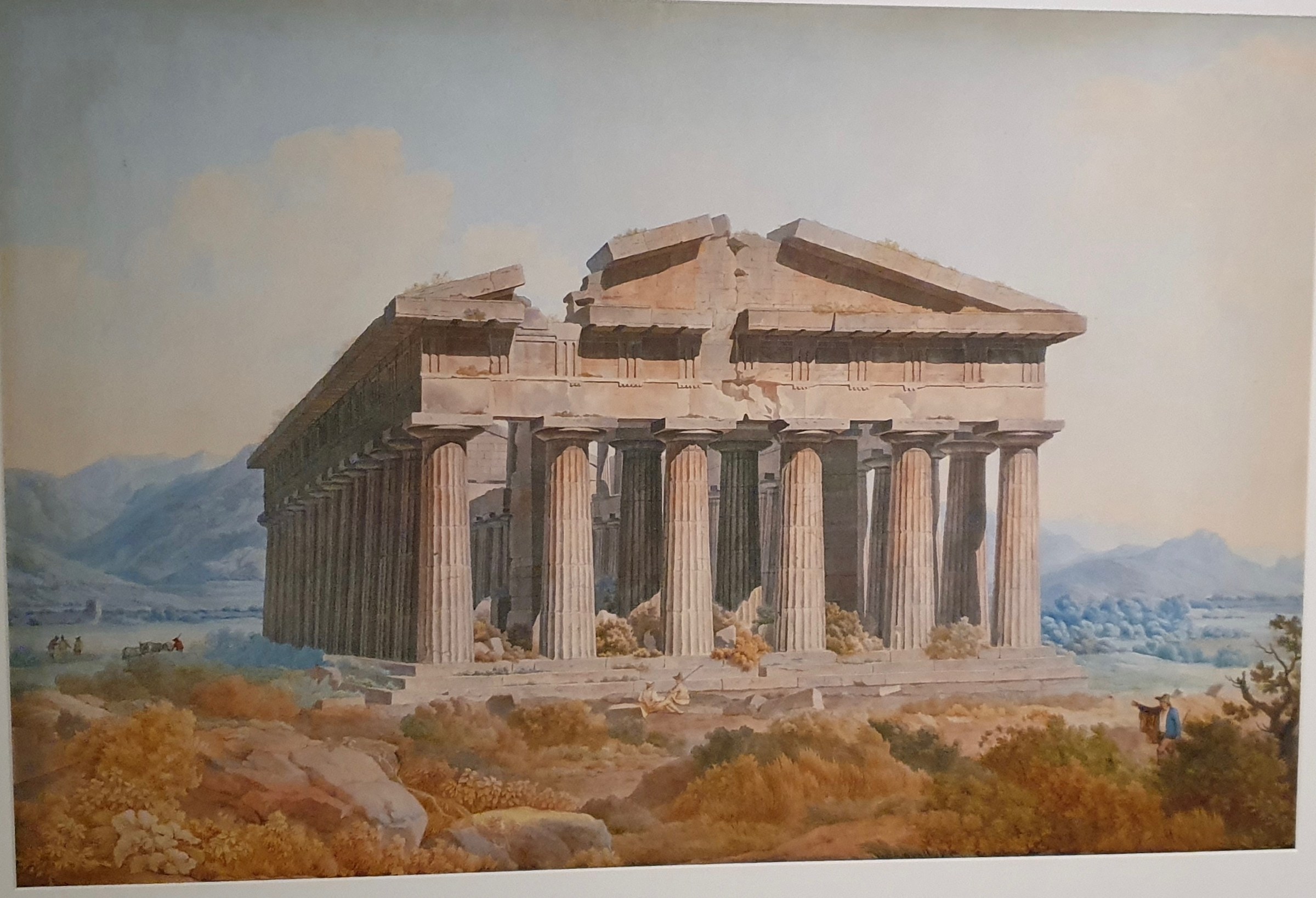
The country grew flatter and more desolate; the scarcity of the buildings bespoke a sparing cultivation. At last, when we were doubting whether we were passing through rocks or ruins, some great oblong masses enabled us to distinguish the remains of temples and other monuments of a once splendid city. Kniep, who had already sketched on the way the two picturesque limestone hills, suddenly stopped to find a spot from which to seize and exhibit the peculiarity of this most unpicturesque region.
A countryman, whom I took for my guide, led me the meanwhile through the buildings. The first sight of them excited nothing but astonishment. I found myself in a perfectly strange world; for, as centuries pass from the severe to the pleasing, they form man’s taste at the same time–indeed, create him after the same law. But now our eyes, and through them our whole inner being, has been used to, and decidedly prepossessed in favor of, a lighter style of architecture; so that these crowded masses of stumpy conical pillars appear heavy, not to say frightful. But I soon recollected myself, called to mind the history of art, thought of the times when the spirit of the age was in unison with this style of architecture, and realised the severe style of sculpture; and in less than an hour found myself reconciled to it,–nay, I went so far as to thank my genius for permitting me to see with my own eyes such well-preserved remains, since drawings give us no true idea of them; for, in architectural sketches, they seem more elegant, and in perspective views even more stumpy than they actually are. It is only by going round them, and passing through them, that you can impart to them their real character; you evoke for them, not to say infuse into them, the very feeling which the architect had in contemplation. And thus I spent the whole day, Kneip the while working away most diligently in taking very accurate sketches. How delighted was I to be exempt from that care, and yet to acquire such unfailing tokens for the aid of memory! Unfortunately, there was no accommodation for spending the night here. We returned to Sorrento, and started early next morning for Naples. Vesuvius, seen from the back, is a rich country; poplars, with their colossal pyramids, on the road-side, in the foreground; these, too, formed an agreeable feature, which we halted a moment to take.
Original German text · Neapel, Freitag, den 23. März 1787.
Nun hat sich das Verhältnis zu Kniep auf eine recht praktische Weise ausgebildet und befestigt. Wir waren zusammen in Pästum, woselbst er, so wie auf der Hin- und Herreise, mit Zeichnen sich auf das tätigste erwies. Die herrlichsten Umrisse sind gewonnen, ihn freut nun selbst dieses bewegte, arbeitsame Leben, wodurch ein Talent aufgeregt wird, das er sich selbst kaum zutraute. Hier gilt es resolut sein; aber gerade hier zeigt sich seine genaue und reinliche Fertigkeit. Das Papier, worauf gezeichnet werden soll, mit einem rechtwinkligen Viereck zu umziehen, versäumt er niemals, die besten englischen Bleistifte zu spitzen und immer wieder zu spitzen, ist ihm fast eine ebenso große Lust als zu zeichnen; dafür sind aber auch seine Konture, was man wünschen kann.
Nun haben wir folgendes verabredet. Von heute an leben und reisen wir zusammen, ohne daß er weiter für etwas sorgt als zu zeichnen, wie diese Tage geschehen. Alle Konture gehören mein, damit aber nach unserer Rückkehr daraus ein ferneres Wirken für ihn entspringe, so führt er eine Anzahl auszuwählender Gegenstände bis auf eine gewisse bestimmte Summe für mich aus; da sich denn indessen bei seiner Geschicklichkeit, bei der Bedeutsamkeit der zu erobernden Aussichten und sonst wohl das Weitere ergeben wird. Diese Einrichtung macht mich ganz glücklich, und jetzt erst kann ich von unserer Fahrt kurze Rechenschaft geben.
Das Land ward immer flacher und wüster, wenige Gebäude deuteten auf kärgliche Landwirtschaft. Endlich, ungewiß, ob wir durch Felsen oder Trümmer führen, konnten wir einige große länglich-viereckige Massen, die wir in der Ferne schon bemerkt hatten, als überbliebene Tempel und Denkmale einer ehemals so prächtigen Stadt unterscheiden. Kniep, welcher schon unterwegs die zwei malerischen Kalkgebirge umrissen, suchte sich schnell einen Standpunkt, von wo aus das Eigentümliche dieser völlig unmalerischen Gegend aufgefaßt und dargestellt werden könnte.
Von einem Landmanne ließ ich mich indessen in den Gebäuden herumführen; der erste Eindruck konnte nur Erstaunen erregen. Ich befand mich in einer völlig fremden Welt. Denn wie die Jahrhunderte sich aus dem Ernsten in das Gefällige bilden, so bilden sie den Menschen mit, ja sie erzeugen ihn so. Nun sind unsere Augen und durch sie unser ganzes inneres Wesen an schlankere Baukunst hinangetrieben und entschieden bestimmt, so daß uns diese stumpfen, kegelförmigen, enggedrängten Säulenmassen lästig, ja furchtbar erscheinen. Doch nahm ich mich bald zusammen, erinnerte mich der Kunstgeschichte, gedachte der Zeit, deren Geist solche Bauart gemäß fand, vergegenwärtigte mir den strengen Stil der Plastik, und in weniger als einer Stunde fühlte ich mich befreundet, ja ich pries den Genius, daß er mich diese so wohl erhaltenen Reste mit Augen sehen ließ, da sich von ihnen durch Abbildung kein Begriff geben läßt. Denn im architektonischen Aufriß erscheinen sie eleganter, in perspektivischer Darstellung plumper, als sie sind, nur wenn man sich um sie her, durch sie durch bewegt, teilt man ihnen das eigentliche Leben mit; man fühlt es wieder aus ihnen heraus, welches der Baumeister beabsichtigte, ja hineinschuf. Und so verbrachte ich den ganzen Tag, indessen Kniep nicht säumte, uns die genausten Umrisse zuzueignen. Wie froh war ich, von dieser Seite ganz unbesorgt zu sein und für die Erinnerung so sichere Merkzeichen zu gewinnen. Leider war keine Gelegenheit, hier zu übernachten, wir kehrten nach Salern zurück, und den andern Morgen ging es zeitig nach Neapel. Der Vesuv, von der Rückseite gesehn, in der fruchtbarsten Gegend; Pappeln pyramidalkolossal an der Chaussee im Vordergrunde. Dies war auch ein angenehmes Bild, das wir durch ein kurzes Stillhalten erwarben.
Naples, 17 May 1787
In a paper herewith inclosed I make some remarks on the way to Salerno and on Pæstum itself; it is the last, and I might almost add, the most splendid idea I bring north with me in a mature state. In my opinion the middle temple is to be preferred to everything still standing in Sicily.
Original German text · Neapel, den 17. Mai 1787.
In einem beiliegenden Blatte sag’ ich etwas über den Weg nach Salerno und über Pästum selbst; es ist die letzte und, fast möcht’ ich sagen, herrlichste Idee, die ich nun nordwärts vollständig mitnehme. Auch ist der mittlere Tempel nach meiner Meinung allem vorzuziehen, was man noch in Sizilien sieht.
Today
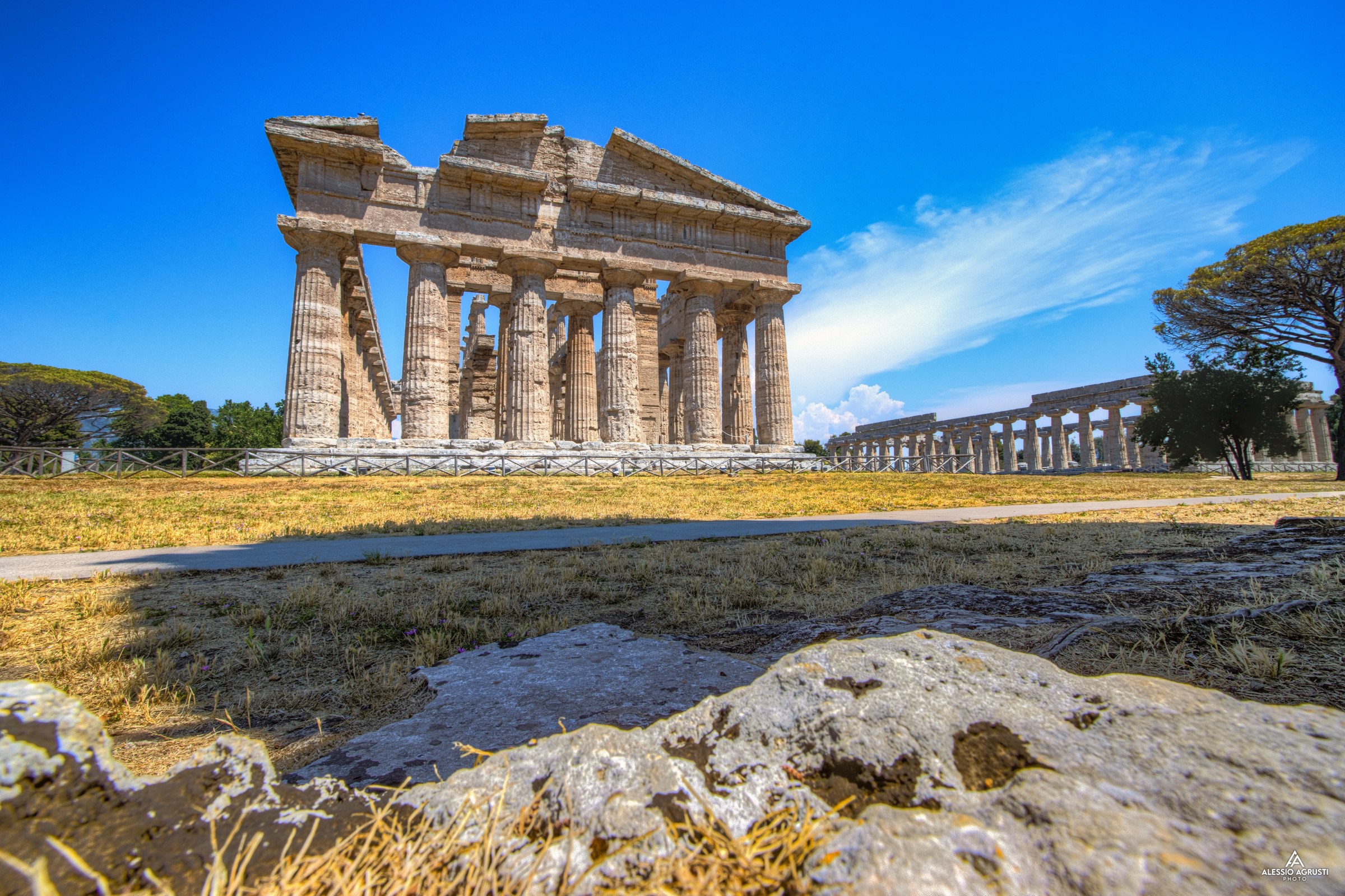
The Archaeological Park of Paestum and Velia; the «middle temple» that Goethe prefers to everything he will see in Sicily is the Temple of Neptune.
Where: Parco Archeologico di Paestum e Velia, Via Magna Grecia 919, 84047 Capaccio Paestum (SA)
Works and documents
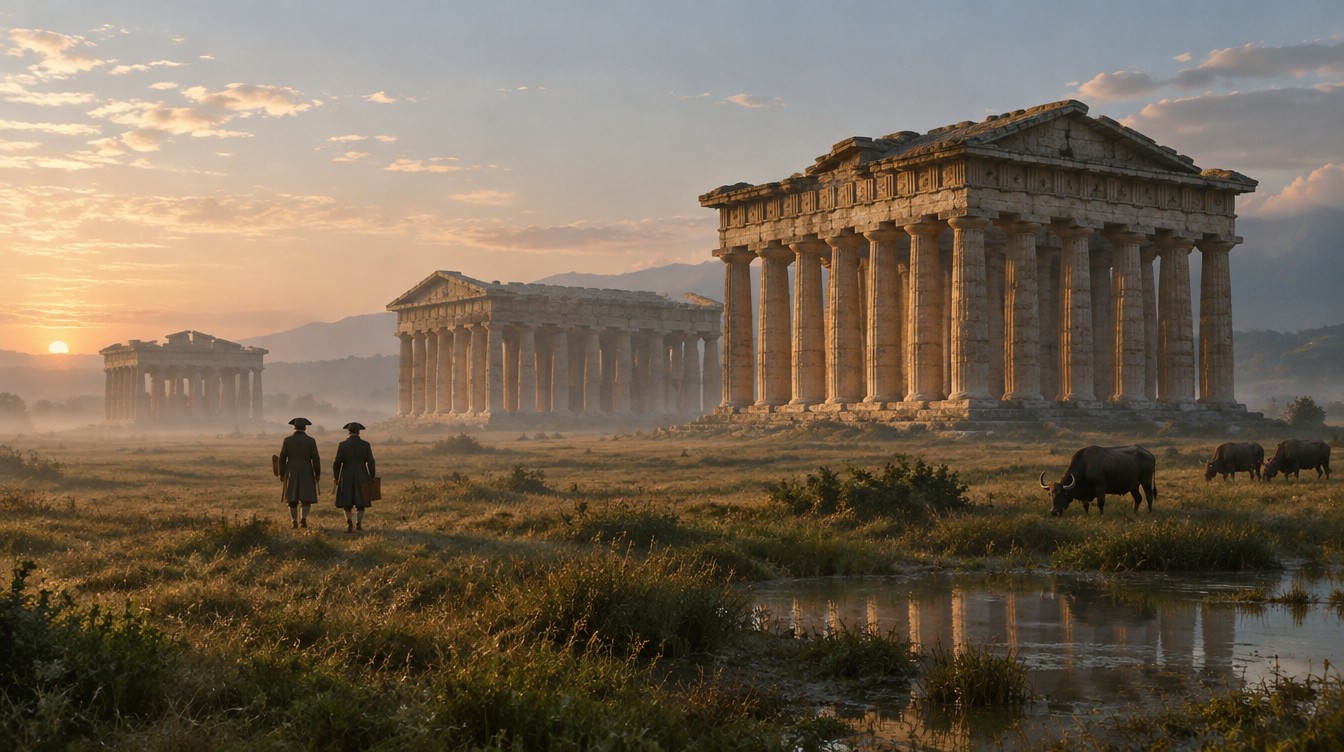
AI reconstruction
Videos
Further reading
Sources
J.W. Goethe, Italienische Reise, original German text (public domain).
Translated by A.J.W. Morrison (Goethe’s Travels in Italy, London, Bell; public domain).
Translated by A.J.W. Morrison and Charles Nisbet (Goethe’s Travels in Italy, London, George Bell and Sons, 1885; public domain).


