


Salerno · The window on the gulf
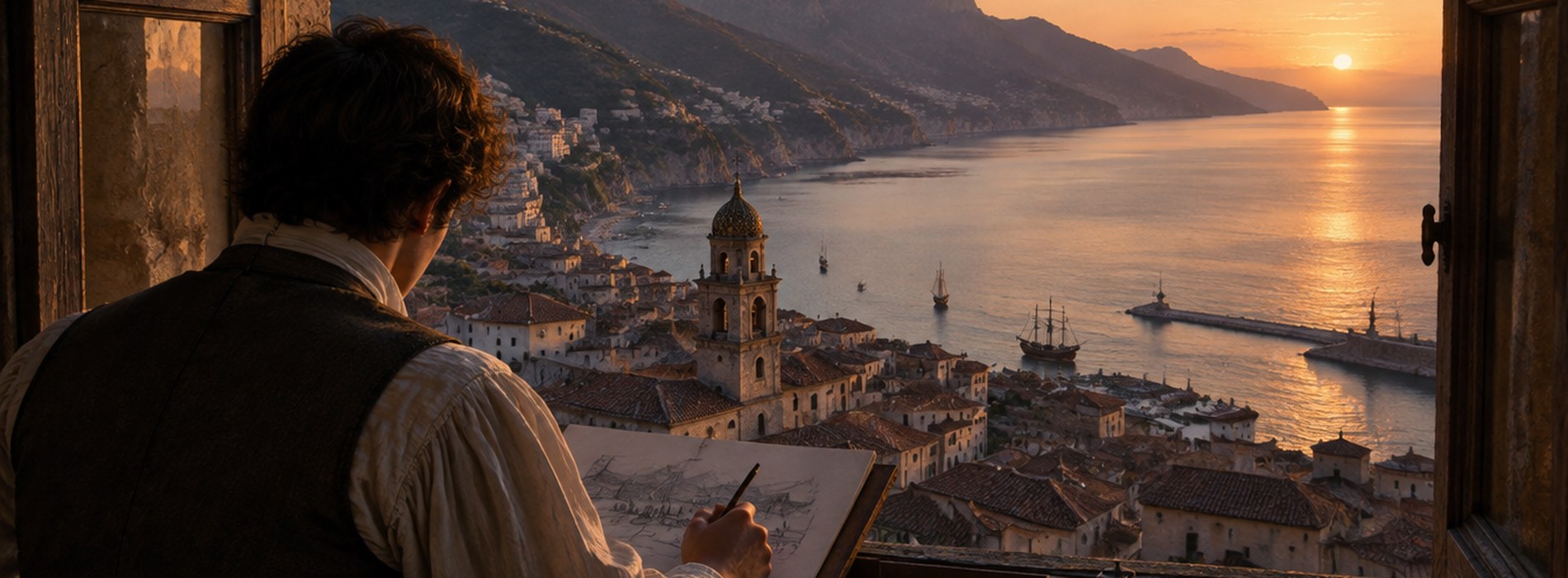
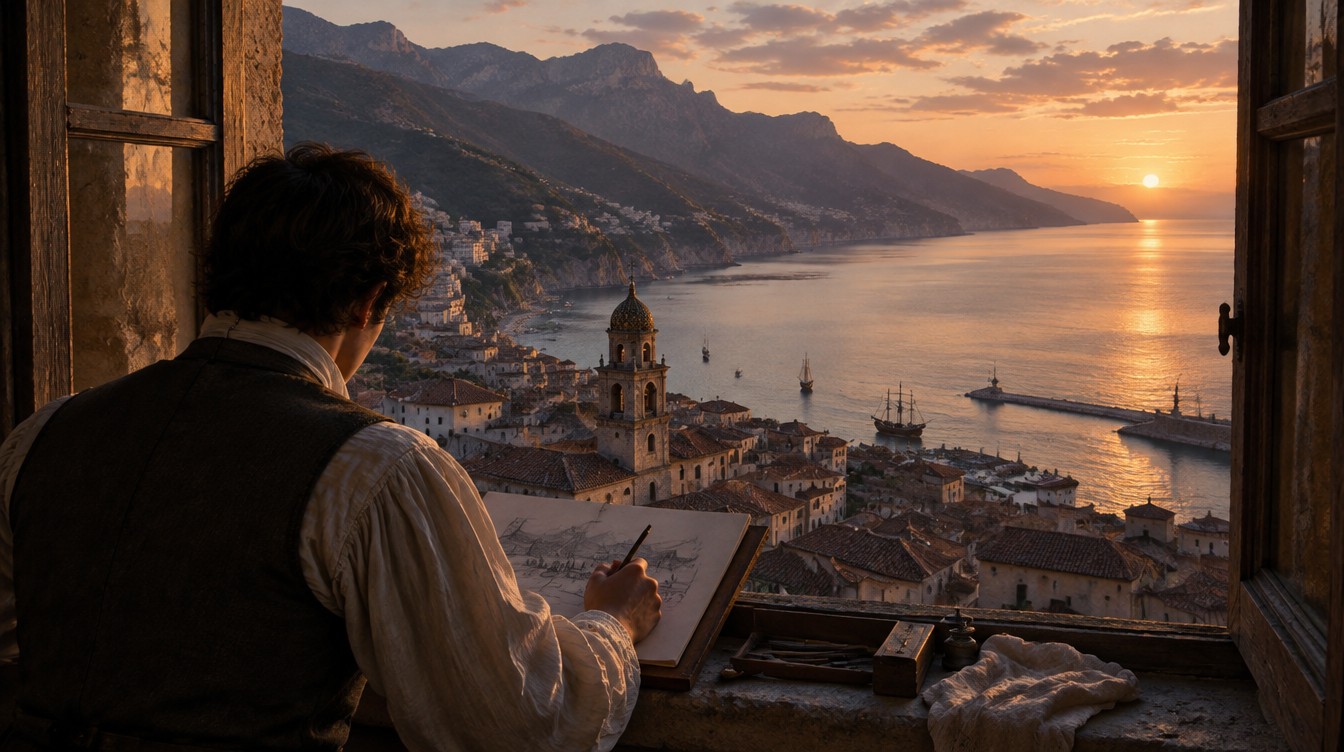
In the evening Kniep draws from the windows at Salerno a view that spares all description; Goethe imagines how fine it would have been to study here in the days of the School. On the way back, from a height, Naples in all its splendour, and the carriage boy shouting for joy: «Signor, perdonate! questa è la mia patria!».
Naples, 23 March 1787
A similar sketch was taken in the evening from the window, of a singularly lovely and rich country, which passes all my powers of description. Who would not have been disposed to study at such a spot, in those bright times, when a high school of art was flourishing? Very early in the morning we set off by an untrodden path, coming occasionally on marshy spots towards two beautifully shaped hills. We crossed brooks and pools, where the wild bulls, like hippopotamuses, were wallowing, and looking upon us with their wild red eyes.
We now reached an eminence. The most extensive area in the world opened before us. Naples, in all its splendour: its mile-long line of houses on the flat shore of the bay, the promontories, tongues of land and walls of rock; then the islands, and, behind all, the sea,–the whole was a ravishing sight.
A most hideous singing, or rather exulting cry and howl of joy, from the boy behind, frightened and disturbed us. Somewhat angrily, I called out to him; he had never had any harsh words from us,–he had been a very good boy.
For a while he did not move; then he patted me lightly on the shoulder, and pushing between us both his right arm, with the fore-finger stretched out, exclaimed, “Signor, perdonate! questa è la mia patria!”–which, being interpreted, runs, “Forgive me, Sir, for that is my native land!” And so I was ravished a second time. Something like a tear stood in the eyes of the phlegmatic child of the north.
Original German text · Neapel, Freitag, den 23. März 1787.
Ein gleicher Umriß ward abends aus den Fenstern von Salern genommen, welcher mich aller Beschreibung überheben wird, einer ganz einzig lieblichen und fruchtbaren Gegend. Wer wäre nicht geneigt gewesen, an diesem Orte zu studieren, zur schönen Zeit der blühenden hohen Schule? Beim frühsten Morgen fuhren wir auf ungebahnten, oft morastigen Wegen einem Paar schön geformten Bergen zu, wir kamen durch Bach und Gewässer, wo wir den nilpferdischen Büffeln in die blutroten wilden Augen sahen.
Nun erreichten wir eine Höhe; der größte Anblick tat sich vor uns auf. Neapel in seiner Herrlichkeit, die meilenlange Reihe von Häusern am flachen Ufer des Golfs hin, die Vorgebirge, Erdzungen, Felswände, dann die Inseln und dahinter das Meer war ein entzückender Anblick.
Ein gräßlicher Gesang, vielmehr Lustgeschrei und Freudegeheul des hintenaufstehenden Knaben erschreckte und störte mich. Heftig fuhr ich ihn an, er hatte noch kein böses Wort von uns gehört, er war der gutmütigste Junge.
Eine Weile rührte er sich nicht, dann klopfte er mir sachte auf die Schulter, streckte seinen rechten Arm mit aufgehobenem Zeigefinger zwischen uns durch und sagte: “Signor, perdonate! questa è la mia patria!” – Das heißt verdolmetscht: “Herr, verzeiht! Ist das doch mein Vaterland!” – Und so war ich zum zweiten Male überrascht. Mir armem Nordländer kam etwas Tränenartiges in die Augen!
Today
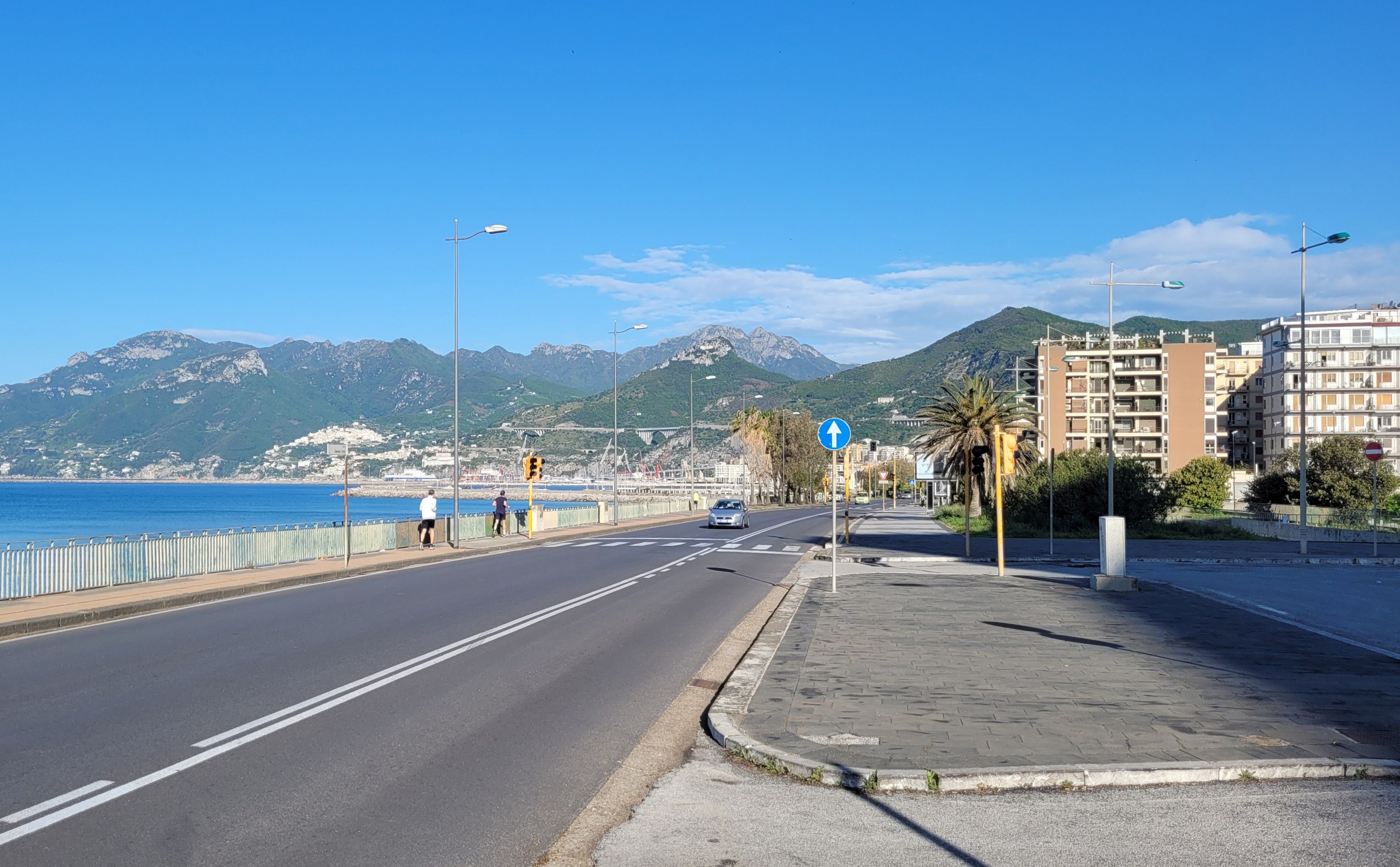
The lodging in Salerno is not named; the city of the Schola Medica Salernitana looks out over the gulf.
Where: Salerno
Works and documents
AI reconstruction
Further reading
Sources
J.W. Goethe, Italienische Reise, original German text (public domain).
Translated by A.J.W. Morrison (Goethe’s Travels in Italy, London, Bell; public domain).


