


Vesuvius · The third ascent, the lava
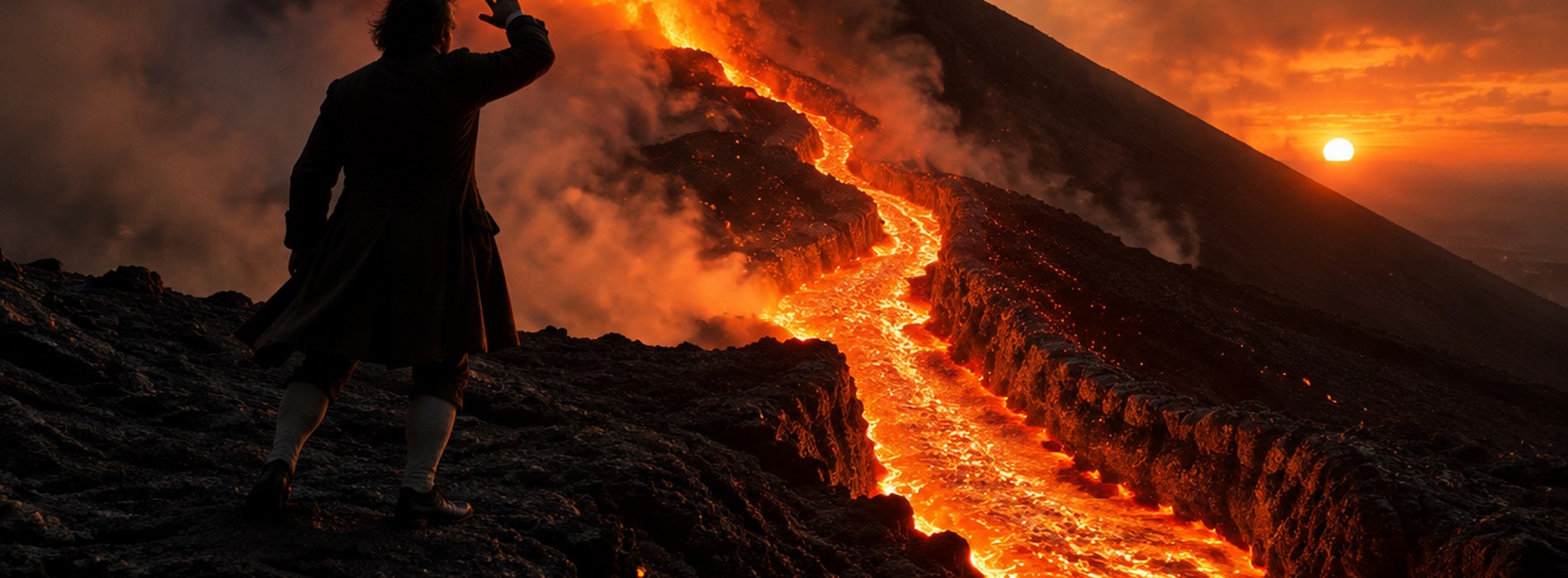
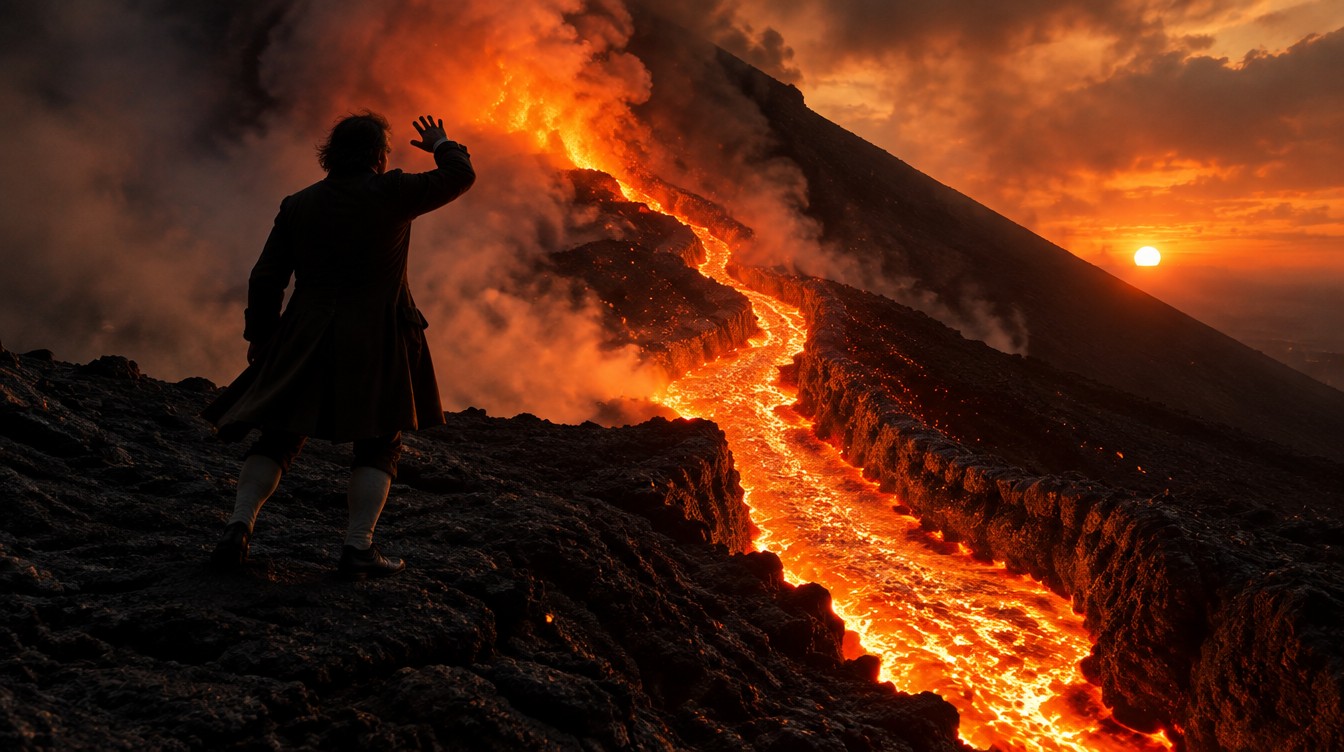
A lava flow invisible from Naples is descending towards Ottaviano: a third ascent. Beneath the cone the lava emerges from the smoke and runs in a channel it builds for itself; Goethe stands on the hardened crust until the heat drives him back. At sunset: the terrible and the beautiful cancel each other out.
Naples, 20 March 1787
The news that an eruption of lava had just commenced, which, taking the direction of Ottajano, was invisible at Naples, tempted me to visit Vesuvius for the third time. Scarcely had I jumped out of my cabriolet (zweirädrigen einpferdigen Fuhrwerk), at the foot of the mountain, when immediately appeared the two guides who had accompanied us on our previous ascent. I had no wish to do without either, but took one out of gratitude and custom, the other for reliance on his judgment,–and the two for the greater convenience. Having ascended the summit, the older guide remained with our cloaks and refreshment, while the younger followed me, and we boldly went straight towards a dense volume of smoke, which broke forth from the bottom of the funnel; then we quickly went downwards by the side of it, till at last, under the clear heaven, we distinctly saw the lava emitted from the rolling clouds of smoke.
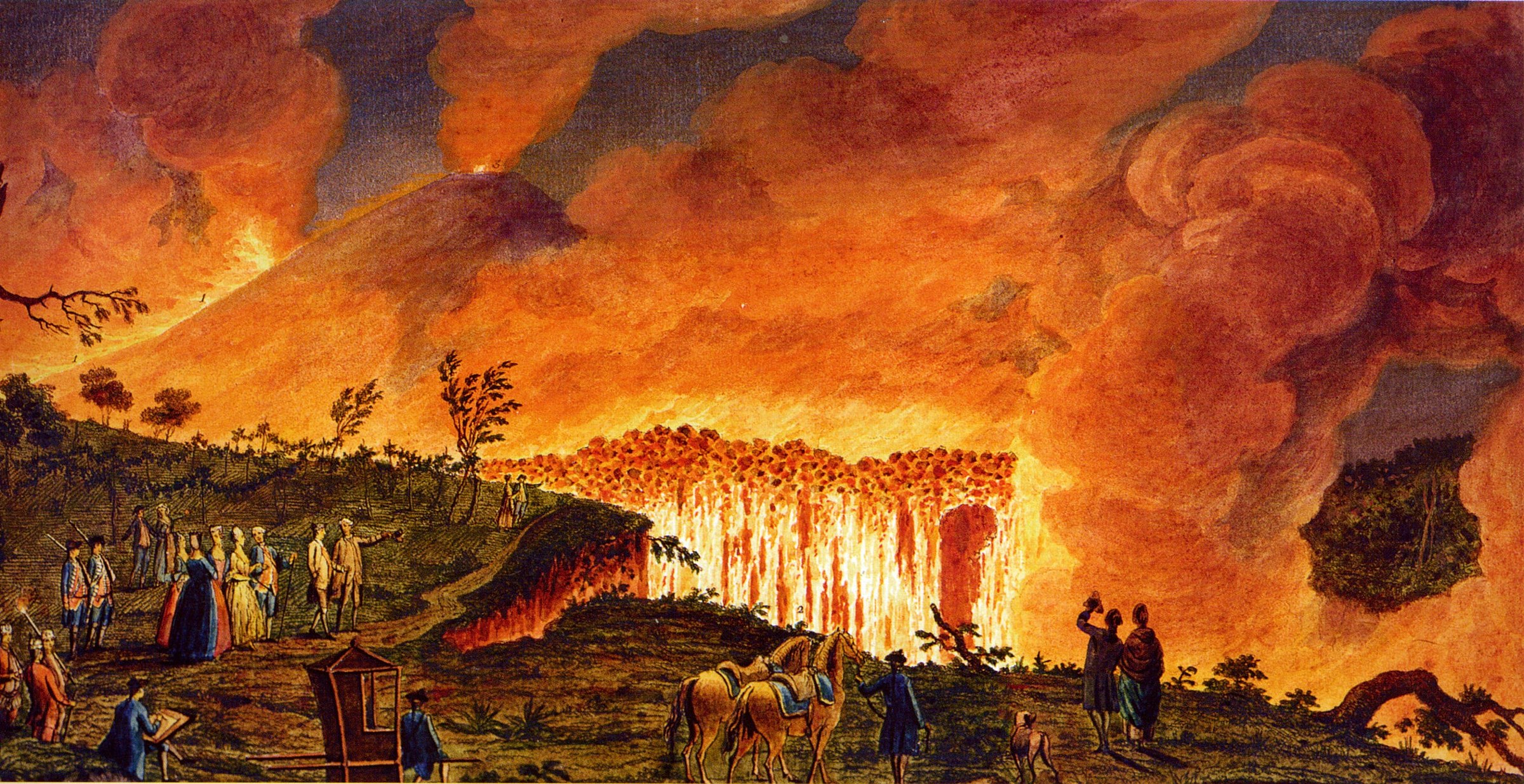
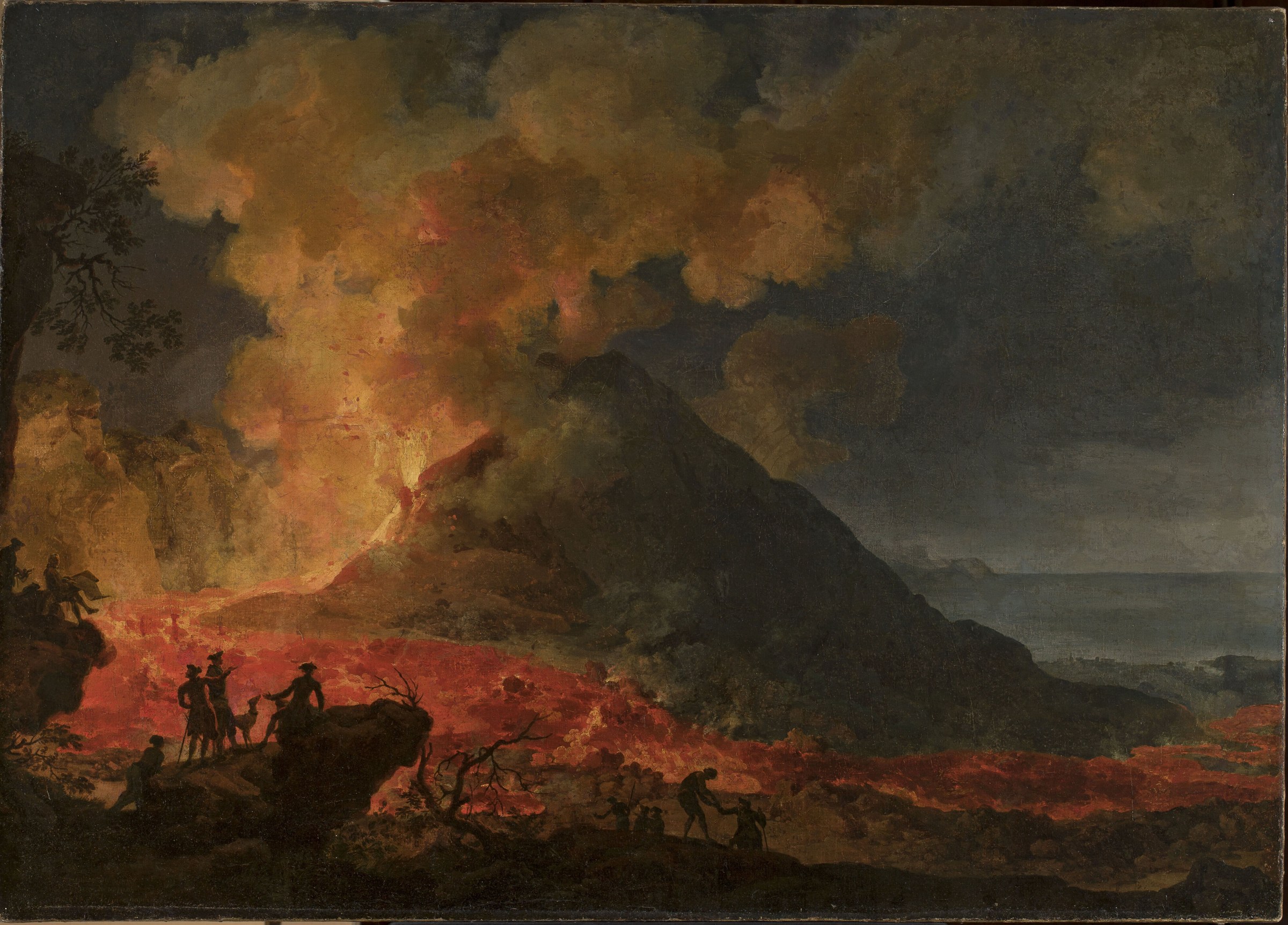
We may hear an object spoken of a thousand times, but its peculiar features will never be caught till we see it with our own eyes. The stream of lava was small, not broader perhaps than ten feet, but the way in which it flowed down a gentle and tolerably smooth plain was remarkable. As it flowed along, it cooled both on the sides and on the surface, so that it formed a sort of canal, the bed of which was continually raised in consequence of the molten mass congealing even beneath the fiery stream, which, with uniform action, precipitated right and left the scoria which were floating on its surface. In this way a regular dam was at length thrown up, in which the glowing stream flowed on as quietly as any mill-stream. We passed along the tolerably high dam, while the scoria rolled regularly off the sides at our feet. Some cracks in the canal afforded opportunity of looking at the living stream from below, and as it rushed onwards, we observed it from above.
A very bright sun made the glowing lava look dull; but a moderate steam rose from it into the pure air. I felt a great desire to go nearer to the point where it broke out from the mountain; there my guide averred, it at once formed vaults and roofs above itself, on which he had often stood. To see and experience this phenomenon, we again ascended the hill, in order to come from behind to this point. Fortunately at this moment the place was cleared by a pretty strong wind, but not entirely, for all round it the smoke eddied from a thousand crannies; and now at last we stood on the top of the solid roof, (which looked like a hardened mass of twisted dough), but which, however, projected so far outwards, that it was impossible to see the welling lava.
We ventured about twenty steps further, but the ground on which we stepped became hotter and hotter, while around us rolled an oppressive steam, which obscured and hid the sun; the guide, who was a few steps in advance of me, presently turned back, and seizing hold of me, hurried out of this Stygian exhalation.
After we had refreshed our eyes with the clear prospect, and washed our gums and throat with wine, we went round again to notice any other peculiarities which might characterise this peak of hell, thus rearing itself in the midst of a Paradise. I again observed attentively some chasms, in appearance like so many Vulcanic forges, which emitted no smoke, but continually shot out a steam of hot glowing air. They were all tapestried, as it were, with a kind of stalactite, which covered the funnel to the top, with its knobs and chintz-like variation of colours. In consequence of the irregularity of the forges, I found many specimens of this sublimation hanging within reach, so that, with our staves and a little contrivance, we were able to hack off a few, and to secure them. I saw in the shops of the dealers in lava similar specimens, labelled simply “Lava;” and I was delighted to have discovered that it was volcanic soot precipitated from the hot vapour, and distinctly exhibiting the sublimated mineral particles which it contained.
The most glorious of sunsets, a heavenly evening, refreshed me on my return; still I felt how all great contrasts confound the mind and senses. From the terrible to the beautiful–from the beautiful to the terrible; each destroys the other, and produces a feeling of indifference. Assuredly, the Neapolitan would be quite a different creature, did he not feel himself thus hemmed in between Elysium and Tartarus.
Original German text · Neapel, Dienstag, den 20. März 1787.
Die Kunde einer soeben ausbrechenden Lava, die, für Neapel unsichtbar, nach Ottajano hinunterfließt, reizte mich, zum dritten Male den Vesuv zu besuchen. Kaum war ich am Fuße desselben aus meinem zweirädrigen, einpferdigen Fuhrwerk gesprungen, so zeigten sich schon jene beiden Führer, die uns früher hinaufbegleitet hatten. Ich wollte keinen missen und nahm den einen aus Gewohnheit und Dankbarkeit, den andern aus Vertrauen, beide der mehreren Bequemlichkeit wegen mit mir.
Auf die Höhe gelangt, blieb der eine bei den Mänteln und Viktualien, der jüngere folgte mir, und wir gingen mutig auf einen ungeheuren Dampf los, der unterhalb des Kegelschlundes aus dem Berge brach; sodann schritten wir an dessen Seite her gelind hinabwärts, bis wir endlich unter klarem Himmel aus dem wilden Dampfgewölke die Lava hervorquellen sahen.
Man habe auch tausendmal von einem Gegenstande gehört, das Eigentümliche desselben spricht nur zu uns aus dem unmittelbaren Anschauen. Die Lava war schmal, vielleicht nicht breiter als zehn Fuß, allein die Art, wie sie eine sanfte, ziemlich ebene Fläche hinabfloß, war auffallend genug; denn indem sie während des Fortfließens an den Seiten und an der Oberfläche verkühlt, so bildet sich ein Kanal, der sich immer erhöht, weil das geschmolzene Material auch unterhalb des Feuerstroms erstarrt, welcher die auf der Oberfläche schwimmenden Schlacken rechts und links gleichförmig hinunterwirft, wodurch sich denn nach und nach ein Damm erhöht, auf welchem der Glutstrom ruhig fortfließt wie ein Mühlbach. Wir gingen neben dem ansehnlich erhöhten Damme her, die Schlacken rollten regelmäßig an den Seiten herunter bis zu unsern Füßen. Durch einige Lücken des Kanals konnten wir den Glutstrom von unten sehen und, wie er weiter hinabfloß, ihn von oben beobachten.
Durch die hellste Sonne erschien die Glut verdüstert, nur ein mäßiger Rauch stieg in die reine Luft. Ich hatte Verlangen, mich dem Punkte zu nähern, wo sie aus dem Berge bricht; dort sollte sie, wie mein Führer versicherte, sogleich Gewölb und Dach über sich her bilden, auf welchem er öfters gestanden habe. Auch dieses zu sehen und zu erfahren, stiegen wir den Berg wieder hinauf, um jenem Punkte von hintenher beizukommen. Glücklicherweise fanden wir die Stelle durch einen lebhaften Windzug entblößt, freilich nicht ganz, denn ringsum qualmte der Dampf aus tausend Ritzen, und nun standen wir wirklich auf der breiartig gewundenen, erstarrten Decke, die sich aber so weit vorwärts erstreckte, daß wir die Lava nicht konnten herausquellen sehen.
Wir versuchten noch ein paar Dutzend Schritte, aber der Boden ward immer glühender; sonneverfinsternd und erstickend wirbelte ein unüberwindlicher Qualm. Der vorausgegangene Führer kehrte bald um, ergriff mich, und wir entwanden uns diesem Höllenbrudel.
Nachdem wir die Augen an der Aussicht, Gaumen und Brust aber am Weine gelabt, gingen wir umher, noch andere Zufälligkeiten dieses mitten im Paradies aufgetürmten Höllengipfels zu beobachten. Einige Schlünde, die als vulkanische Essen keinen Rauch, aber eine glühende Luft fortwährend gewaltsam ausstoßen, betrachtete ich wieder mit Aufmerksamkeit. Ich sah sie durchaus mit einem tropfsteinartigen Material tapeziert, welches zitzen- und zapfenartig die Schlünde bis oben bekleidete. Bei der Ungleichheit der Essen fanden sich mehrere dieser herabhängenden Dunstprodukte ziemlich zur Hand, so daß wir sie mit unsern Stäben und einigen hakenartigen Vorrichtungen gar wohl gewinnen konnten. Bei dem Lavahändler hatte ich schon dergleichen Exemplare unter der Rubrik der wirklichen Laven gefunden, und ich freute mich, entdeckt zu haben, daß es vulkanischer Ruß sei, abgesetzt aus den heißen Schwaden, die darin enthaltenen verflüchtigten mineralischen Teile offenbarend.
Der herrlichste Sonnenuntergang, ein himmlischer Abend erquickten mich auf meiner Rückkehr; doch konnte ich empfinden, wie sinneverwirrend ein ungeheurer Gegensatz sich erweise. Das Schreckliche zum Schönen, das Schöne zum Schrecklichen, beides hebt einander auf und bringt eine gleichgültige Empfindung hervor. Gewiß wäre der Neapolitaner ein anderer Mensch, wenn er sich nicht zwischen Gott und Satan eingeklemmt fühlte.
Today
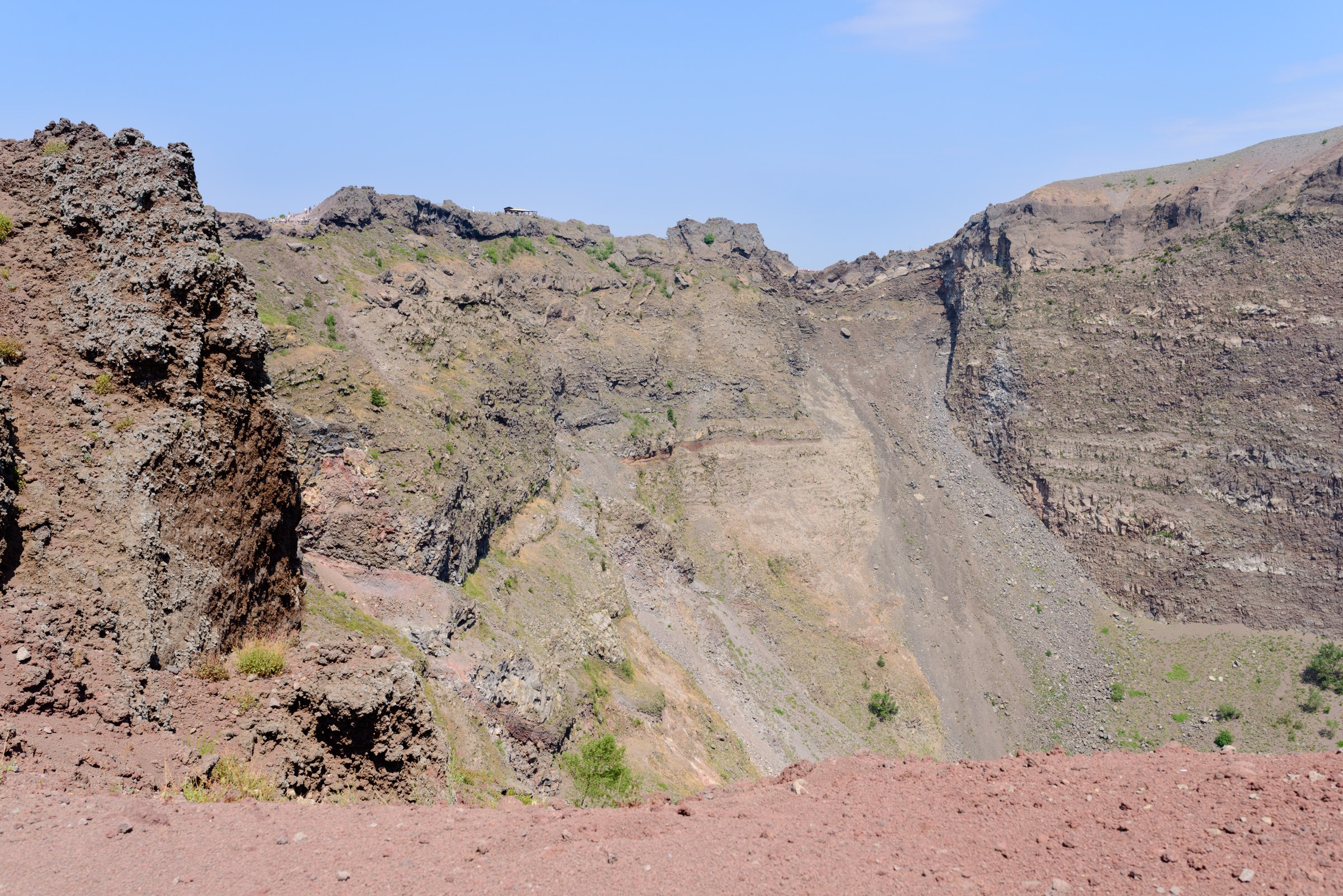
The Great Cone, north-eastern slope towards Ottaviano, in the Vesuvius National Park; the exact spot cannot be identified.
Where: Gran Cono del Vesuvio, Parco Nazionale del Vesuvio (NA)
Works and documents
AI reconstruction
Further reading
Sources
J.W. Goethe, Italienische Reise, original German text (public domain).
Translated by A.J.W. Morrison (Goethe’s Travels in Italy, London, Bell; public domain).


