


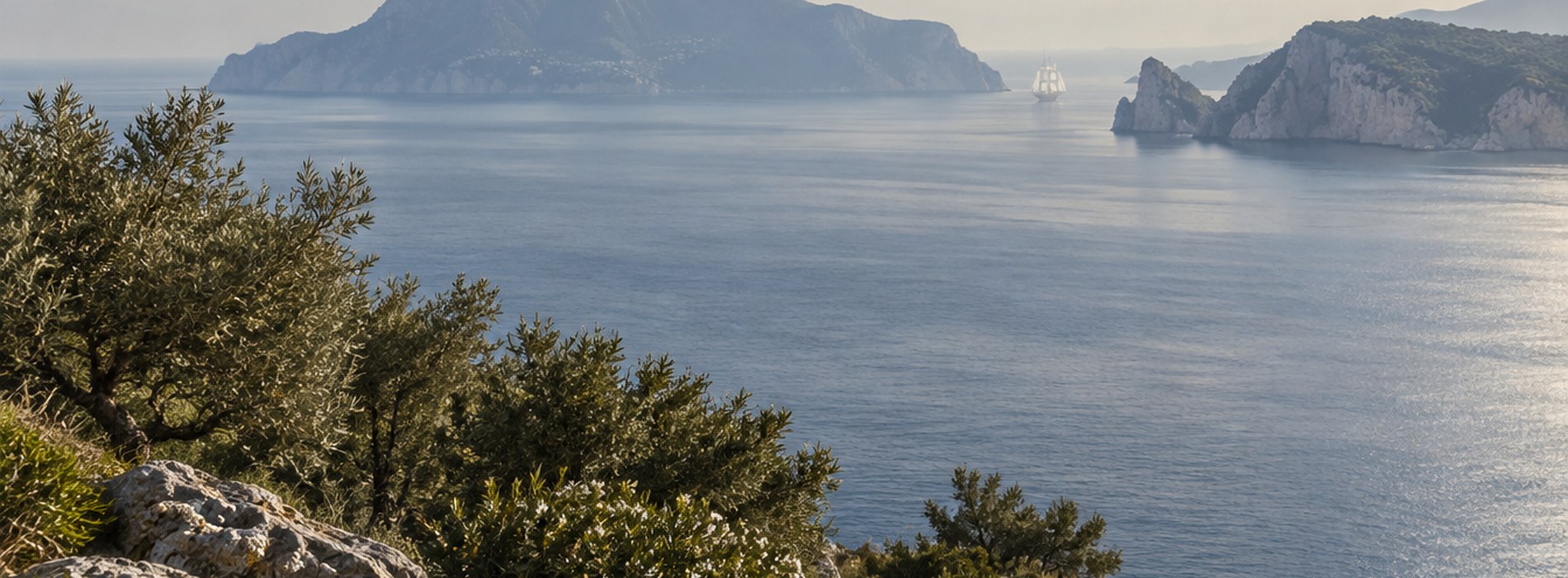
Capri and Punta Campanella · From the sea
Three views from the sea: the sails of the Palermo frigate vanishing between Capri and Capo Minerva; the dawn of the departure for Sicily, with Kniep drawing the coasts; and on the return, on 14 May, the most beautiful sunset of the journey and the current driving the ship towards the cliffs of Capri, to the brink of shipwreck.
Naples, 3 March 1787
The sea, with its vessels, and their destinations, presents wholly new matters for reflection. The frigate for Palermo started yesterday, with a strong, direct, north wind. This time it certainly will not be more than six-and-thirty hours on the passage. With what longing did I not watch the full sails as the vessel passed between Capri and Cape Minerva, until at last it disappeared. Who could see one’s beloved thus sailing away and survive? The sirocco (south wind) is now blowing; if the wind becomes stronger, the breakers over the Mole will be glorious.
Original German text · Neapel, den 3. März.
Das See- und Schiffwesen gewährt auch ganz neue Zustände. Die Fregatte nach Palermo ging mit reiner, starker Tramontane gestern ab. Diesmal hat sie gewiß nicht über sechsunddreißig Stunden auf der Fahrt zugebracht. Mit welcher Sehnsucht sah ich den vollen Segeln nach, als das Schiff zwischen Capri und Kap Minerva durchfuhr und endlich verschwand. Wenn man jemand Geliebtes so fortfahren sähe, müßte man vor Sehnsucht sterben! Jetzt weht der Scirocco; wenn der Wind stärker wird, werden die Wellen um den Molo lustig genug sein.
At sea, 30 March 1787
By day-break we found ourselves between Ischia and Capri—perhaps not more than a mile from the latter. The sun rose from behind the mountains of Capri and Cape Minerva. Kniep diligently sketched the outlines of the coasts and the islands, and took several beautiful views. The slowness of the passage was favourable to his labours. We were making our way but slowly under a light side-wind. We lost sight of Vesuvius about four, just as we came in view of Cape Minerva and Ischia. These, too, disappeared about evening. The sun set in the sea, attended with clouds, and a long streak of light, reaching for miles, all of a brilliant purple. This phenomenon was also sketched by Kniep. At last we lost sight altogether of the land, and the watery horizon surrounded us, the night being clear, with lovely moonlight.
These beautiful sights, however, I could only enjoy for a few moments, for I was soon attacked with sea-sickness. I betook myself to my cabin, chose an horizontal position, and abstaining from all meat or drink, except white bread and red wine, soon found myself pretty comfortable again. Shut out from the external world, I let the internal have full sway; and, as a tedious voyage was to be anticipated, I immediately set myself a heavy task in order to while away the time profitably. Of all my papers I had only brought with me the first two acts of “Tasso,” written in poetic prose. These two acts, as regards their plan and evolution, were nearly similar to the present ones, but, written full ten years ago, had a somewhat soft and misty tone, which soon disappeared, while, in accordance with my later notions, I made form more predominant, and introduced more of rhythm.
Original German text · Seefahrt, Freitag, den 30. März 1787
Bei Tagesanbruch fanden wir uns zwischen Ischia und Capri, ungefähr von letzterem eine Meile. Die Sonne ging hinter den Gebirgen von Capri und Capo Minerva herrlich auf. Kniep zeichnete fleißig die Umrisse der Küsten und Inseln und ihre verschiedenen Ansichten; die langsame Fahrt kam seiner Bemühung zustatten. Wir setzten mit schwachem und halbem Winde unsern Weg fort. Der Vesuv verlor sich gegen vier Uhr aus unsern Augen, als Capo Minerva und Ischia noch gesehen wurden. Auch diese verloren sich gegen Abend. Die Sonne ging unter ins Meer, begleitet von Wolken und einem langen, meilenweit reichenden Streifen, alles purpurglänzende Lichter. Auch dieses Phänomen zeichnete Kniep. Nun war kein Land mehr zu sehen, der Horizont ringsum ein Wasserkreis, die Nacht hell und schöner Mondschein.
Ich hatte doch dieser herrlichen Ansichten nur Augenblicke genießen können, die Seekrankheit überfiel mich bald. Ich begab mich in meine Kammer, wählte die horizontale Lage, enthielt mich außer weißem Brot und rotem Wein aller Speisen und Getränke und fühlte mich ganz behaglich. Abgeschlossen von der äußern Welt, ließ ich die innere walten, und da eine langsame Fahrt vorauszusehen war, gab ich mir gleich zu bedeutender Unterhaltung ein starkes Pensum auf. Die zwei ersten Akte des “Tasso”, in poetischer Prosa geschrieben, hatte ich von allen Papieren allein mit über See genommen. Diese beiden Akte, in Absicht auf Plan und Gang ungefähr den gegenwärtigen gleich, aber schon vor zehn Jahren geschrieben, hatten etwas Weichliches, Nebelhaftes, welches sich bald verlor, als ich nach neueren Ansichten die Form verwalten und den Rhythmus eintreten ließ.
At sea, 14 May 1787
And thus mid-day passed without our being able, as we wished, to get into the Bay of Naples. On the contrary, we were continually driven more and more to the west, and our vessel, nearing the island of Capri, kept getting further from Cape Minerva. Every one was annoyed and impatient; we two, however, who could contemplate the world with a painter’s eye, had enough to content us, when the setting sun presented for our enjoyment the most beautiful prospect that we had yet witnessed during our whole tour. Cape Minerva, with the mountains which abut on it, lay before our eyes in the brilliant colouring of sunset, while the rocks which stretched southwards from the headland, had already assumed a bluish tint. The whole coast, stretching from the Cape to Sorrento, was gloriously lit up. Vesuvius was visible; an immense cloud of smoke stood above it like a tower, and sent out a long streak southwards—the result, probably, of a violent eruption. On the left lay Capri, rising perpendicularly in the air; and by the help of the transparent blue halo, we were able distinctly to trace the forms of its rocky walls. Beneath a perfectly clear and cloudless sky glittered the calm, scarcely rippling sea, which at last, when the wind died away, lay before us exactly like a clear pool. We were enraptured with the sight. Kniep regretted that all the colours of art were inadequate to convey an idea of this harmony, and that not even the finest of English pencils would enable the most practised hand to give the delicacy of the outline. I, for my part, convinced that to possess even a far poorer memorial of the scene than this clever artist could produce, would greatly contribute to my future enjoyment, exhorted him to strain both his hand and eye for the last time. He allowed himself to be persuaded, and produced a most accurate drawing (which he afterwards coloured); and so bequeathed to me a proof, that to truly artistic powers of delineation, the impossible becomes the possible. With equally attentive eyes we watched the transition from evening to night. Capri now lay quite black before us, and, to our astonishment, the smoke of Vesuvius turned into flame, as, indeed, did the whole streak, which, the longer we observed it, became brighter and brighter; at last we saw a considerable region of the atmosphere, forming, as it were, the back ground of our natural picture, lit up—and, indeed, lightening.
We were so entirely occupied with these welcome scenes, that we did not notice the great danger we were in. However, the commotion among the passengers did not allow us to continue long in ignorance of it. Those who were better acquainted with maritime affairs than ourselves were bitterly reproaching the captain and his steersman. By their bungling, they said, they had not only missed the mouth of the strait, but they were very nigh losing the lives of all the passengers intrusted to them, cargo and all. We inquired into the grounds of these apprehensions, especially as we could not conceive how, during a perfect calm, there could be any cause for alarm. But it was this very calm that rendered these people so inconsolable. “We are,” they said, “in the current which runs round the island, and which, by a slow but irresistible ground-swell, will draw us against the rugged rocks, where there is neither the slightest footing, nor the least cove to save ourselves by.
Made more attentive by these declarations, we contemplated our fate with horror. For, although the deepening night did not allow us to distinguish the approach of danger, still we observed that the ship, as it rolled and pitched, was gradually nearing the rocks, which grew darker and darker upon the eye, while a light evening glow was still playing on the water. Not the slightest movement was to be discerned in the air. Handkerchiefs and light ribbons were constantly being held up, but not the slightest indication of the much desired breath of wind was discernible. The tumult became every moment louder and wilder. The women with their children were on the deck praying, not indeed on their knees, for there was scarcely room for them to move, but lying close pressed one upon another. Every now and then, too, they would rate and scold the captain more harshly and more bitterly than the men, who were calmer, thinking over every chance of helping and saving the vessel. They reproached him with everything which, during the passage up to this point, had been borne with silence—the bad accommodation, the high passage money, the scanty bill of fare, his own manners—which, if not absolutely surly, were certainly forbidding enough. He would not give an account of his proceedings to any one; indeed, ever since the evening before he had maintained a most obstinate silence as to his plans, and what he was doing with his vessel. He and the steersman were called mere money-making adventurers, who having no knowledge at all of navigation, had managed to buy a packet with a mere view to profit, and now, by their incapacity and bungling, were on the point of losing all that had been intrusted to their care. The captain, however, maintained his usual silence under all these reproaches, and appeared to be giving all his thoughts to the chances of saving his ship. As for myself, since I had always felt a greater horror of anarchy than of death itself, I found it quite impossible to hold my tongue any longer. I went up to the noisy railers, and, addressed them with almost as much composure of mind as the rogues of Malsesine. I represented to them that, by their shrieking and bawling, they must confound both the ears and the brains of those on whom all at this moment depended for our safety, so that they could neither think nor communicate with one another. All that you have to do, I said, is to calm yourselves, and then to offer up a fervent prayer to the Mother of God, asking her to intercede with her blessed Son to do for you what He did for His Apostles when on the lake Tiberias. The waves broke over the boat while the Lord slept, but Who when, helpless and inconsolable, they awoke Him, commanded the winds to be still; and Who, if it is only His heavenly will, can even now command the winds to rise. These few words had the best effect possible. One of the men with whom I had previously had some conversation on moral and religious subjects, exclaimed, “Ah, il Balarmé! Benedetto il Balarmé!” and they actually began, as they were already prostrate on their knees, to go over their rosaries with more than usual fervour. They were able to do this with the greater calmness, as the sailors were now trying an expedient the object of which was, at any rate, apparent to every eye. The boat (which would not, however, hold more than six or eight men) was let down and fastened by a long rope to the ship, which, by dint of hard rowing, they hoped to be able to tow after them. And, indeed, it was thought that they did move it within the current, and hopes began to be entertained of soon seeing the vessel towed entirely out of it. But whether their efforts increased the counteraction of the current, or whatever it was, the boat with its crew at the end of the hawser was suddenly drawn in a kind of a bow towards the vessel, forming with the long rope a kind of bow—or just like the lash of a whip when the driver makes a blow with it. This plan, therefore, was soon given up. Prayer now began to alternate with weeping—for our state began to appear alarming indeed, when from the deck we could clearly distinguish the voices of the goatherds, (whose fires on the rocks we had long seen), crying to one another, “There is a vessel stranding below.” They also said something else, but the sounds were unintelligible to me; those, however, who understood their patois, interpreted them as exclamations of joy, to think of the rich booty they would reap in the morning. Thus the doubt which we had entertained whether the ship was actually nearing the rocks, and in any immediate danger, was unfortunately too soon dispelled, and we saw the sailors preparing boat-poles and fenders, in order, should it come to the worst, to be ready to hold the vessel off the rocks—so long at least as their poles did not break, in which case all would be inevitably lost. The ship now rolled more violently than ever, and the breakers seemed to increase upon us. And my sickness returning upon me in the midst of it all, made me resolve to return to the cabin. Half stupefied, I threw myself down on my mattress, still with a somewhat pleasant feeling, which seemed to me to come over from the Sea of Tiberias, for the picture in Merian’s Pictorial Bible kept floating before my mind’s eye. And so it is: our moral impressions invariably prove strongest in those moments when we are most driven back upon ourselves. How long I lay in this sort of half stupor I know not, for I was awakened by a great noise overhead; I could distinctly make out that it was caused by great ropes being dragged along the deck, and this gave me a hope that they were going to make use of the sails. A little while after this Kniep hurried down into the cabin to tell me that we were out of danger, for a gentle breeze had sprung up; that all hands had just been at work in hoisting the sails, and that he himself had not hesitated to lend a hand. We were visibly getting clear off the rocks; and although not entirely out of the current, there was now a good hope of our being able to make way against it. All was now still again overhead, and soon several more of the passengers came below to announce the happy turn of affairs, and to lie down.
Original German text · Seefahrt, Montag, den 14. Mai 1787
Und so war der Nachmittag vorbeigegangen, ohne daß wir unsern Wünschen gemäß in den Golf von Neapel eingefahren wären. Wir wurden vielmehr immer westwärts getrieben, und das Schiff, indem es sich der Insel Capri näherte, entfernte sich immer mehr von dem Kap Minerva. Jedermann war verdrießlich und ungeduldig, wir beiden aber, die wir die Welt mit malerischen Augen betrachteten, konnten damit sehr zufrieden sein; denn bei Sonnenuntergang genossen wir des herrlichsten Anblicks, den uns die ganze Reise gewährt hatte. In dem glänzendsten Farbenschmuck lag Kap Minerva mit den daranstoßenden Gebirgen vor unsern Augen, indes die Felsen, die sich südwärts hinabziehen, schon einen blaulichen Ton angenommen hatten. Vom Kap an zog sich die ganze erleuchtete Küste bis Sorrent hin. Der Vesuv war uns sichtbar, eine ungeheure Dampfwolke über ihm aufgetürmt, von der sich ostwärts ein langer Streif weit hinzog, so daß wir den stärksten Ausbruch vermuten konnten. Links lag Capri, steil in die Höhe strebend; die Formen seiner Felswände konnten wir durch den durchsichtigen bläulichen Dunst vollkommen unterscheiden. Unter einem ganz reinen, wolkenlosen Himmel glänzte das ruhige, kaum bewegte Meer, das bei einer völligen Windstille endlich wie ein klarer Teich vor uns lag. Wir entzückten uns an dem Anblick, Kniep trauerte, daß alle Farbenkunst nicht hinreiche, diese Harmonie wiederzugeben, so wie der feinste englische Bleistift die geübteste Hand nicht in den Stand setze, diese Linien nachzuziehen. Ich dagegen, überzeugt, daß ein weit geringeres Andenken, als dieser geschickte Künstler zu erhalten vermochte, in der Zukunft höchst wünschenswert sein würde, ich ermunterte ihn, Hand und Auge zum letztenmal anzustrengen; er ließ sich bereden und lieferte eine der genausten Zeichnungen, die er nachher kolorierte und ein Beispiel zurückließ, daß bildlicher Darstellung das Unmögliche möglich wird. Den Übergang vorn Abend zur Nacht verfolgten wir mit ebenso begierigen Augen. Capri lag nun ganz finster vor uns, und zu unserm Erstaunen entzündete sich die vesuvische Wolke sowie auch der Wolkenstreif, je länger, je mehr, und wir sahen zuletzt einen ansehnlichen Strich der Atmosphäre im Grunde unseres Bildes erleuchtet, ja, wetterleuchten. über diese uns so willkommenen Szenen hatten wir unbemerkt gelassen, daß uns ein großes Unheil bedrohe; doch ließ uns die Bewegung unter den Passagieren nicht lange in Ungewißheit. Sie, der Meeresereignisse kundiger als wir, machten dem Schiffsherrn und seinem Steuermanne bittre Vorwürfe; daß über ihre Ungeschicklichkeit nicht allein die Meerenge verfehlt sei, sondern auch die ihnen anvertraute Personenzahl, Güter und alles umzukommen in Gefahr schwebe. Wir erkundigten uns nach der Ursache dieser Unruhe, indem wir nicht begriffen, daß bei völliger Windstille irgendein Unheil zu befürchten sei. Aber eben diese Windstille machte jene Männer trostlos. “Wir befinden uns”, sagten sie, “schon in der Strömung, die sich um die Insel bewegt und durch einen sonderbaren Wellenschlag so langsam als unwiderstehlich nach dem schroffen Felsen hinzieht, wo uns auch nicht ein Fußbreit Vorsprung oder Bucht zur Rettung gegeben ist.”
Aufmerksam durch diese Reden, betrachteten wir nun unser Schicksal mit Grauen; denn obgleich die Nacht die zunehmende Gefahr nicht unterscheiden ließ, so bemerkten wir doch, daß das Schiff, schwankend und schwippend, sich den Felsen näherte, die immer finsterer vor uns standen, während über das Meer hin noch ein leichter Abendschimmer verbreitet lag. Nicht die geringste Bewegung war in der Luft zu bemerken: Schnupftücher und leichte Bänder wurden von jedem in die Höhe und ins Freie gehalten, aber keine Andeutung eines erwünschten Hauches zeigte sich. Die Menge ward immer lauter und wilder. Nicht etwa betend knieten die Weiber mit ihren Kindern auf dem Verdeck, sondern weil der Raum zu eng war, sich darauf zu bewegen, lagen sie gedrängt aneinander. Sie noch mehr als die Männer, welche besonnen auf Hülfe und Rettung dachten, schalten und tobten gegen den Kapitän. Nun ward ihm alles vorgeworfen, was man auf der ganzen Reise schweigend zu erinnern gehabt: für teures Geld einen schlechten Schiffsraum, geringe Kost, ein zwar nicht unfreundliches, aber doch stummes Betragen. Er hatte niemand von seinen Handlungen Rechenschaft gegeben, ja, selbst noch den letzten Abend ein hartnäckiges Stillschweigen über seine Manoeuvres beobachtet. Nun hieß er und der Steuermann hergelaufene Krämer, die ohne Kenntnis der Schiffskunst sich aus bloßem Eigennutz den Besitz eines Fahrzeuges zu verschaffen gewußt und nun durch Unfähigkeit und Ungeschicklichkeit alle, die ihnen anvertraut, zugrunde richteten. Der Hauptmann schwieg und schien immer noch auf Rettung zu sinnen; mir aber, dem von Jugend auf Anarchie verdrießlicher gewesen als der Tod selbst, war es unmöglich, länger zu schweigen. Ich trat vor sie hin und redete ihnen zu, mit ungefähr ebensoviel Gemütsruhe als den Vögeln von Malcesine. Ich stellte ihnen vor, daß gerade in diesem Augenblick ihr Lärmen und Schreien denen, von welchen noch allein Rettung zu hoffen sei, Ohr und Kopf verwirrten, so daß sie weder denken noch sich untereinander verständigen könnten. “Was euch betrifft”, rief ich aus, “kehrt in euch selbst zurück und dann wendet euer brünstiges Gebet zur Mutter Gottes, auf die es ganz allein ankommt, ob sie sich bei ihrem Sohne verwenden mag, daß er für euch tue, was er damals für seine Apostel getan, als auf dem stürmenden See Tiberias die Wellen schon in das Schiff schlugen, der Herr aber schlief, der jedoch, als ihn die Trost- und Hülflosen aufweckten, sogleich dem Winde zu ruhen gebot, wie er jetzt der Luft gebieten kann, sich zu regen, wenn es anders sein heiliger Wille ist.”
Diese Worte taten die beste Wirkung. Eine unter den Frauen, mit der ich mich schon früher über sittliche und geistliche Gegenstände unterhalten hatte, rief aus: “Ah! il Barlamé! benedetto il Barlamé!” und wirklich fingen sie, da sie ohnehin schon auf den Knieen lagen, ihre Litaneien mit mehr als herkömmlicher Inbrunst leidenschaftlich zu beten an. Sie konnten dies mit desto größerer Beruhigung tun, als die Schiffsleute noch ein Rettungsmittel versuchten, das wenigstens in die Augen fallend war: sie ließen das Boot hinunter, das freilich nur sechs bis acht Männer fassen konnte, befestigten es durch ein langes Seil an das Schiff, welches die Matrosen durch Ruderschläge nach sich zu ziehen kräftig bemüht waren. Auch glaubte man einen Augenblick, daß sie es innerhalb der Strömung bewegten, und hoffte es bald aus derselben herausgerettet zu sehen. Ob aber gerade diese Bemühungen die Gegengewalt der Strömung vermehrt, oder wie es damit beschaffen sein mochte, so ward mit einmal an dem langen Seile das Boot und seine Mannschaft im Bogen rückwärts nach dem Schiffe geschleudert, wie die Schmitze einer Peitsche, wenn der Fuhrmann einen Zug tut. Auch diese Hoffnung ward aufgegeben! – Gebet und Klagen wechselten ab, und der Zustand wuchs um so schauerlicher, da nun oben auf den Felsen die Ziegenhirten, deren Feuer man schon längst gesehen hatte, hohl aufschrien, da unten strande das Schiff! Sie riefen einander noch viel unverständliche Töne zu, in welchen einige, mit der Sprache bekannt, zu vernehmen glaubten, als freuten sie sich auf manche Beute, die sie am andern Morgen aufzufischen gedächten. Sogar der tröstliche Zweifel, ob denn auch wirklich das Schiff dem Felsen sich so drohend nähere, war leider nur zu bald gehoben, indem die Mannschaft zu großen Stangen griff, um das Fahrzeug, wenn es zum äußersten käme, damit von den Felsen abzuhalten, bis denn endlich auch diese brächen und alles verloren sei. Immer stärker schwankte das Schiff, die Brandung schien sich zu vermehren, und meine durch alles dieses wiederkehrende Seekrankheit drängte mir den Entschluß auf, hinunter in die Kajüte zu steigen. Ich legte mich halb betäubt auf meine Matratze, doch aber mit einer gewissen angenehmen Empfindung, die sich vom See Tiberias herzuschreiben schien; denn ganz deutlich schwebte mir das Bild aus Merians Kupferbibel vor Augen. Und so bewährt sich die Kraft aller sinnlich-sittlichen Eindrücke jedesmal am stärksten, wenn der Mensch ganz auf sich selbst zurückgewiesen ist. Wie lange ich so in halbem Schlafe gelegen, wüßte ich nicht zu sagen, aufgeweckt aber ward ich durch ein gewaltsames Getöse über mir; ich konnte deutlich vernehmen, daß es die großen Seile waren, die man auf dem Verdeck hin und wider schleppte, dies gab mir Hoffnung, daß man von den Segeln Gebrauch mache. Nach einer kleinen Weile sprang Kniep herunter und kündigte mir an, daß man gerettet sei, der gelindeste Windshauch habe sich erhoben; in dem Augenblick sei man bemüht gewesen, die Segel aufzuziehen, er selbst habe nicht versäumt, Hand anzulegen. Man entferne sich schon sichtbar vom Felsen, und obgleich noch nicht völlig außer der Strömung, hoffe man nun doch, sie zu überwinden. Oben war alles stille; sodann kamen mehrere der Passagiere, verkündigten den glücklichen Ausgang und legten sich nieder.
Today
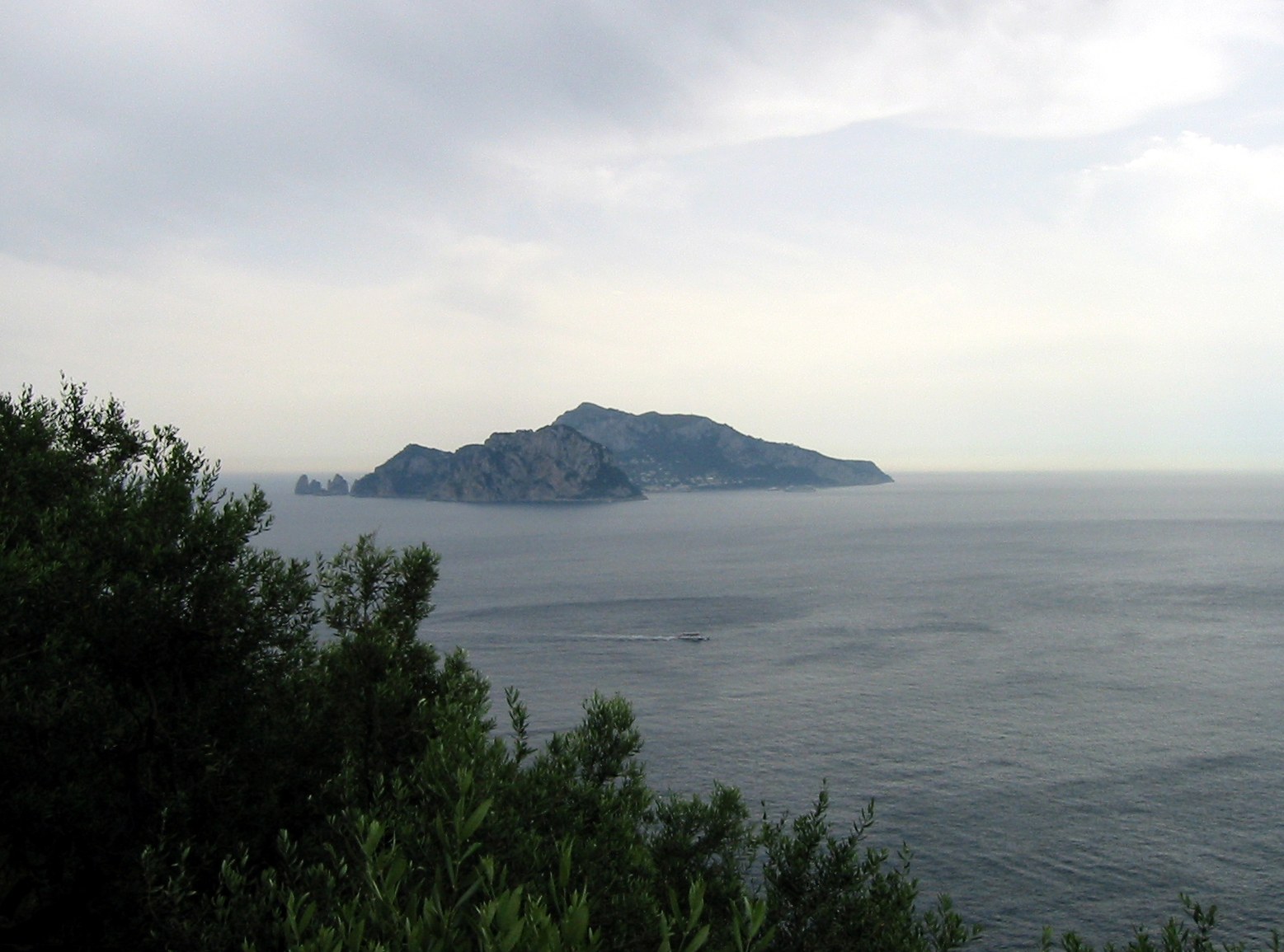
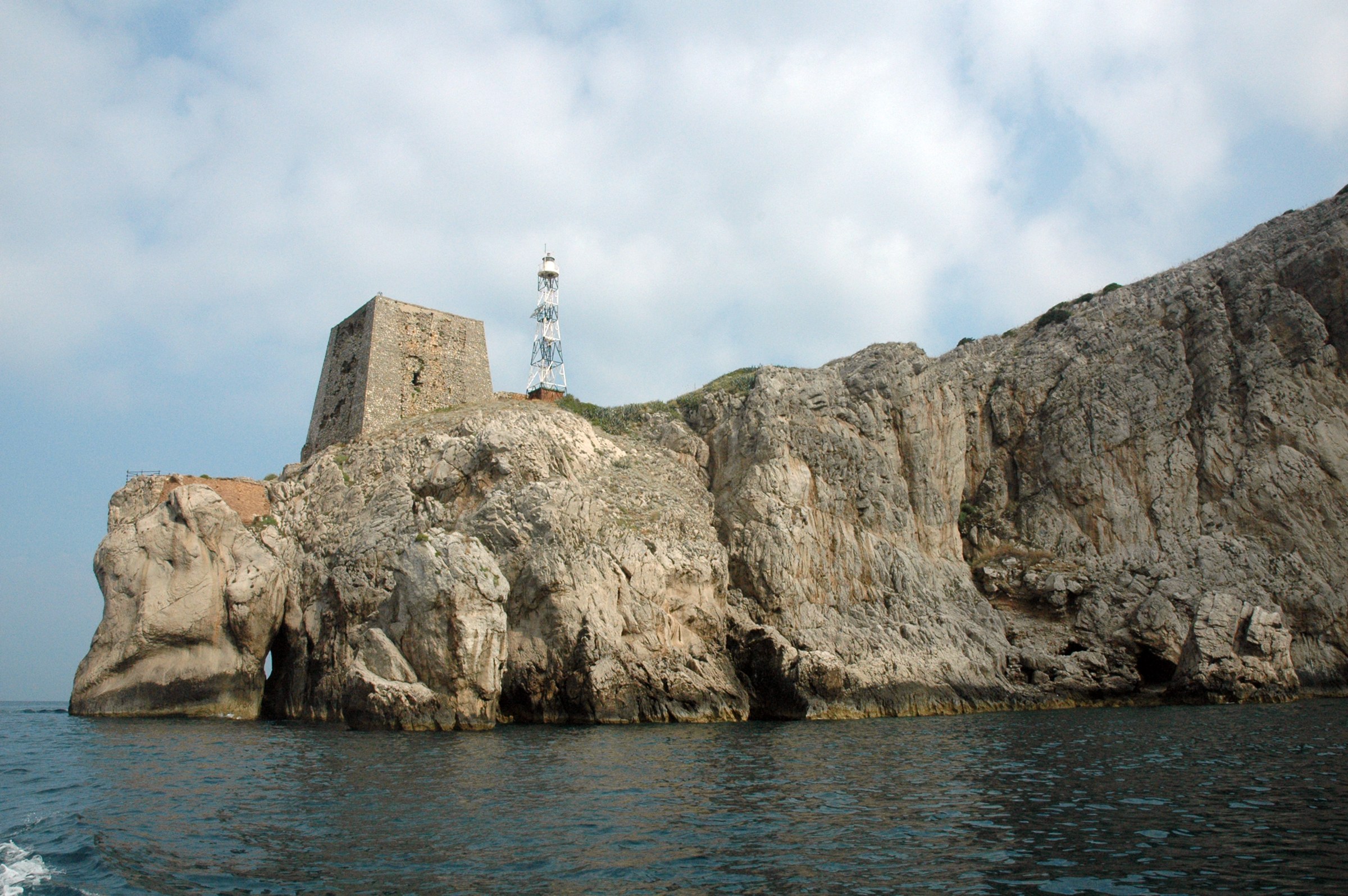
The Bocche di Capri between the island and Punta Campanella (Massa Lubrense), today a protected marine area; the spot of the near-shipwreck cannot be identified.
Where: Area Marina Protetta Punta Campanella, Massa Lubrense (NA)
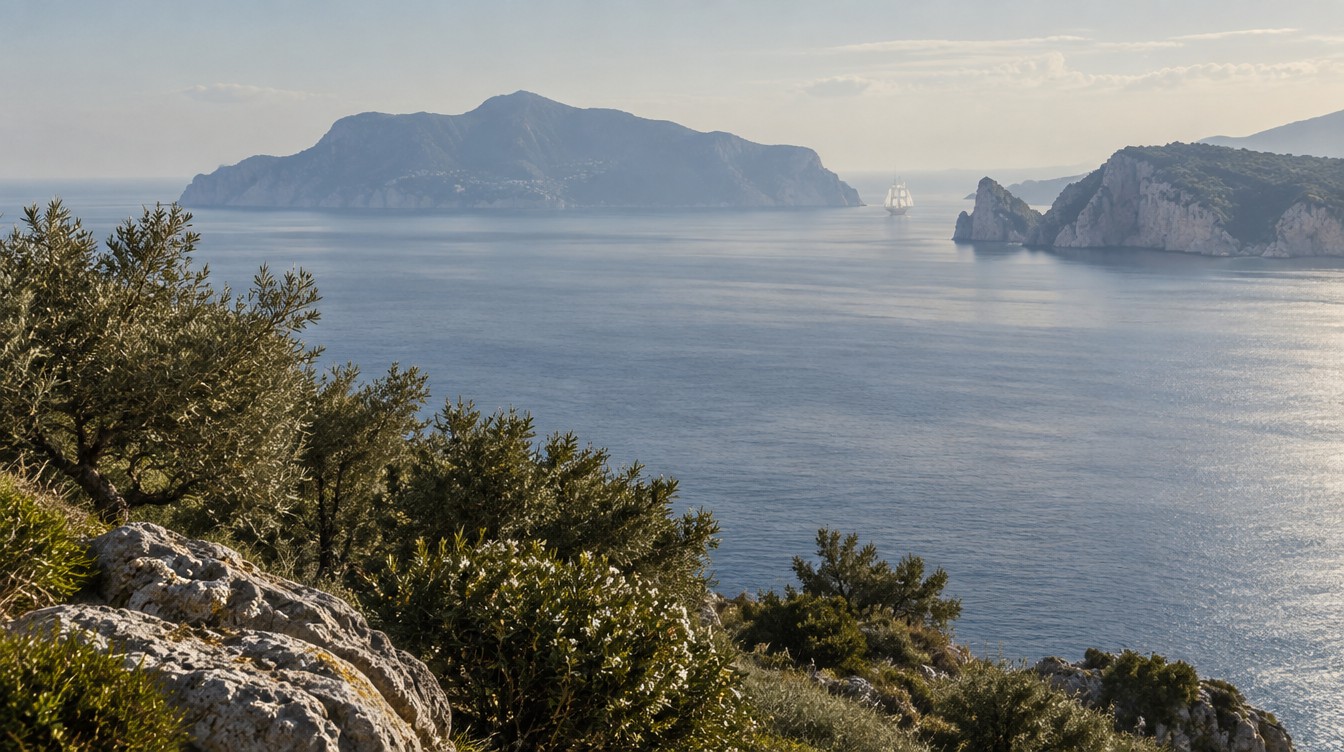
AI reconstruction
Further reading
Sources
J.W. Goethe, Italienische Reise, original German text (public domain).
Translated by A.J.W. Morrison (Goethe’s Travels in Italy, London, Bell; public domain).


