


Naples · Palazzo Colubrano, the horse’s head
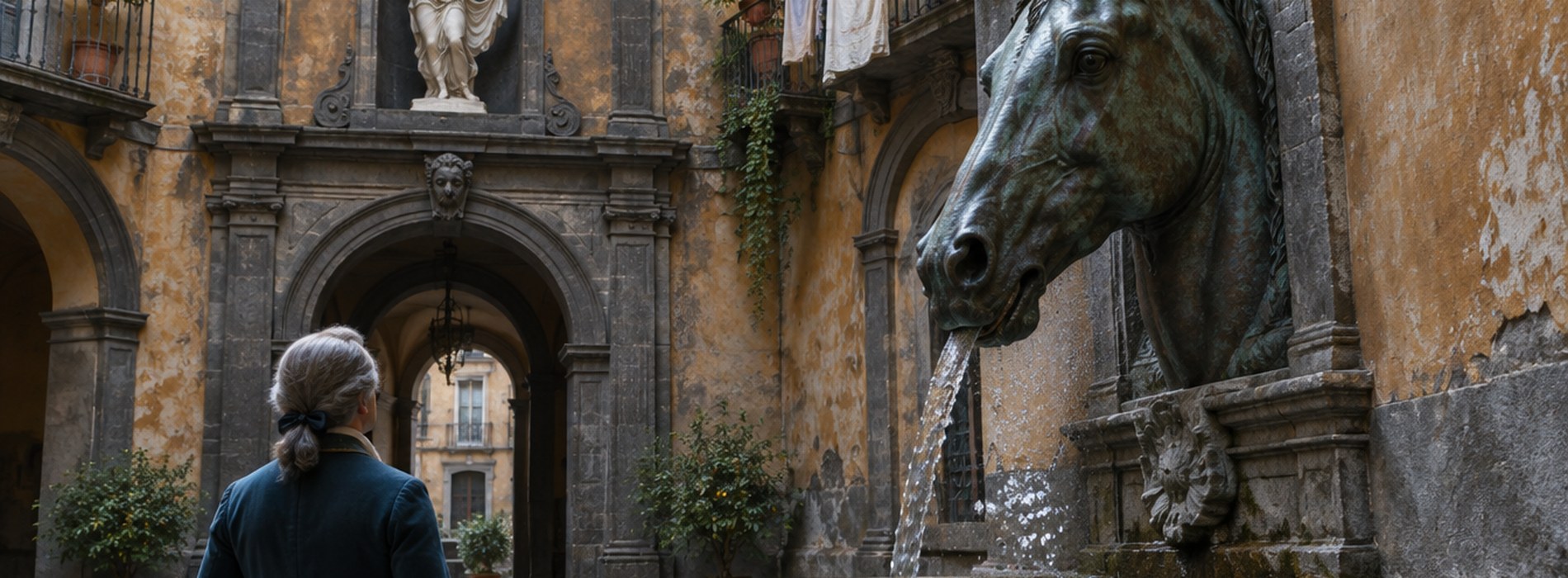
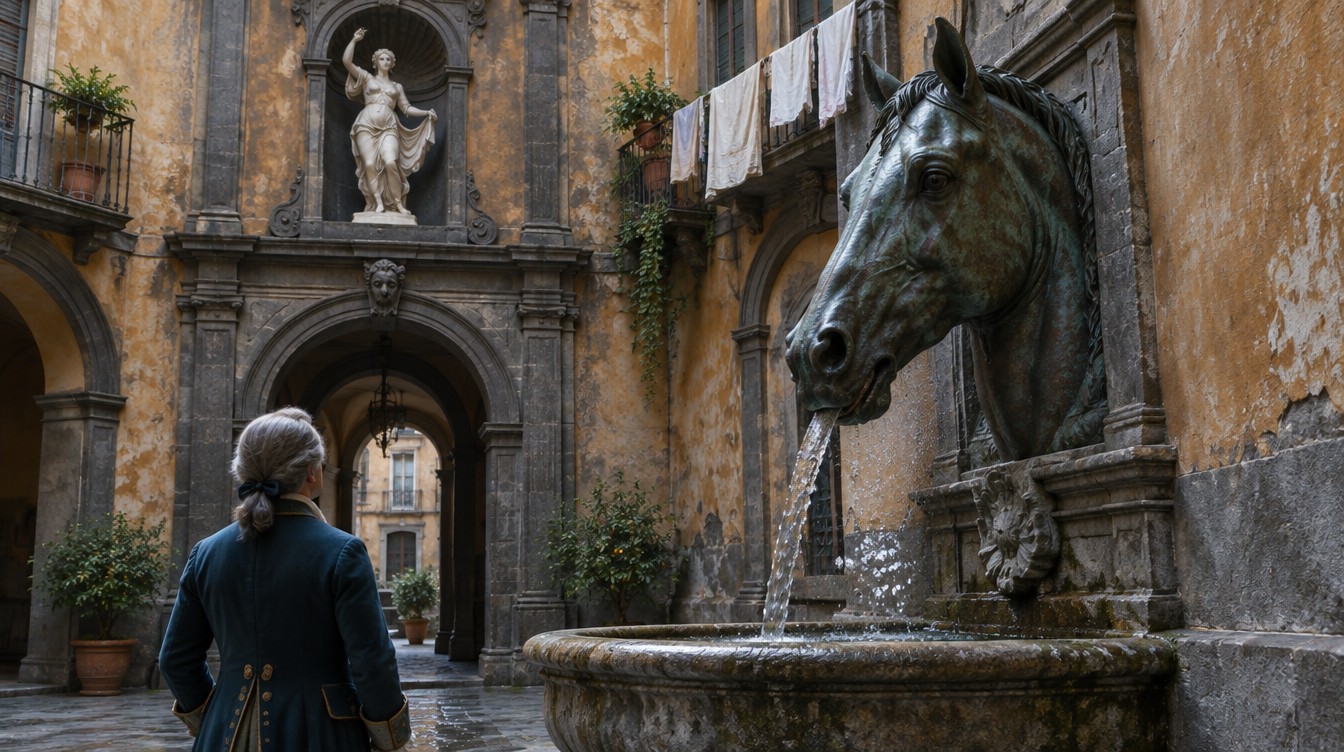
In the courtyard of the Palazzo Colubrano, above a fountain, the colossal bronze horse’s head: mighty brow, quivering nostrils, pricked ears. Over the gateway a female statue that Winckelmann already took for a dancer and that «would deserve a better place».
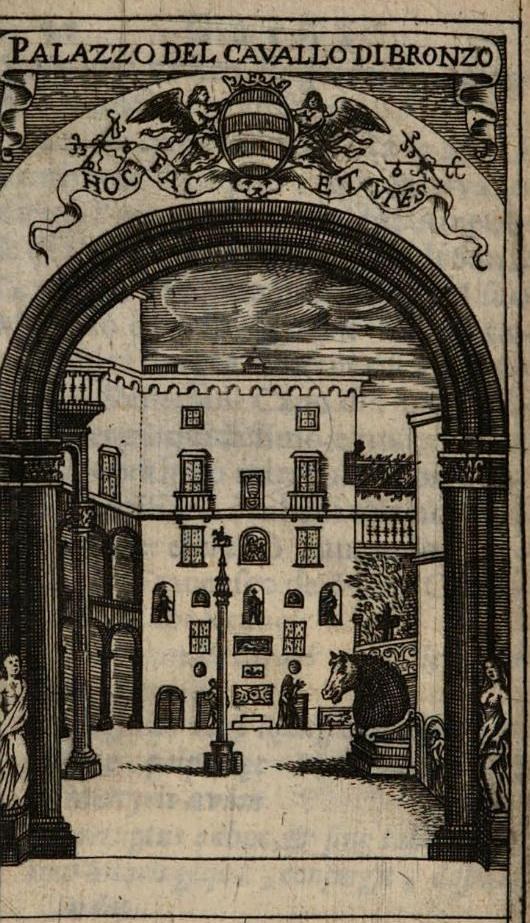
Naples, 7 March 1787
This week Tischbein has shown to me, and without reserve commented upon, the greater part of the artistic treasures of Naples. An excellent judge and drawer of animals, he had long before called my attention to a horse’s head in brass in the Palace Columbrano: we went there to-day. This relic of art is placed in the court right opposite the gateway, in a niche over a well, and really excites one’s astonishment. What must have been the effect of the whole head and body together? The perfect horse must have been far larger than those at S. Mark’s: moreover, the head alone, when closely viewed, enables you distinctly to recognise and admire the character and spirit of the animal. The splendid frontal bones, the snorting nostrils, the pricked ears, the stiff mane,—a strong, excited, and spirited creature!
We turned round to notice a female statue which stands in a niche over the gateway. It has been already described by Winckelmann as an imitation of a dancing girl, with the remark, that such artistes represent to us in living movement, and under the greatest variety, that beauty of form which the masters of statuary exhibit in the (as it were) petrified nymphs and goddesses. It is very light and beautiful; the head, which had been broken off, has been skilfully set on again: otherwise it is nowise injured, and most assuredly deserves a better place.
Original German text · Neapel, Mittwoch, den 7. März 1787.
Und so hat mir diese Woche Tischbein redlich einen großen Teil der Kunstschätze von Neapel gezeigt und ausgelegt. Er, ein trefflicher Tierkenner und Zeichner, machte mich schon früher aufmerksam auf einen Pferdekopf von Erz im Palast Colombrano. Wir gingen heute dahin. Dieser Kunstrest steht gerade der Torfahrt gegenüber im Hofe in einer Nische über einem Brunnen und setzt in Erstaunen; was muß das Haupt erst mit den übrigen Gliedern, zu einem Ganzen verbunden, für Wirkung getan haben! Das Pferd im ganzen war viel größer als die auf der Markuskirche, auch läßt hier das Haupt, näher und einzeln beschaut, Charakter und Kraft nur desto deutlicher erkennen und bewundern. Der prächtige Stirnknochen, die schnaubende Nase, die aufmerkenden Ohren, die starre Mähne! Ein mächtig aufgeregtes, kräftiges Geschöpf.
Wir kehrten uns um, eine weibliche Statue zu bemerken, die über dem Torwege in einer Nische stand. Sie wird für die Nachbildung einer Tänzerin schon von Winckelmann gehalten, wie denn solche Künstlerinnen in lebendiger Bewegung auf das mannigfaltigste dasjenige vorstellen, was die bildenden Meister uns als erstarrte Nymphen und Göttinnen aufbewahren. Sie ist sehr leicht und schön, der Kopf war abgebrochen, ist aber gut wieder aufgesetzt, übrigens nichts daran versehrt, und verdiente wohl einen bessern Platz.
Today
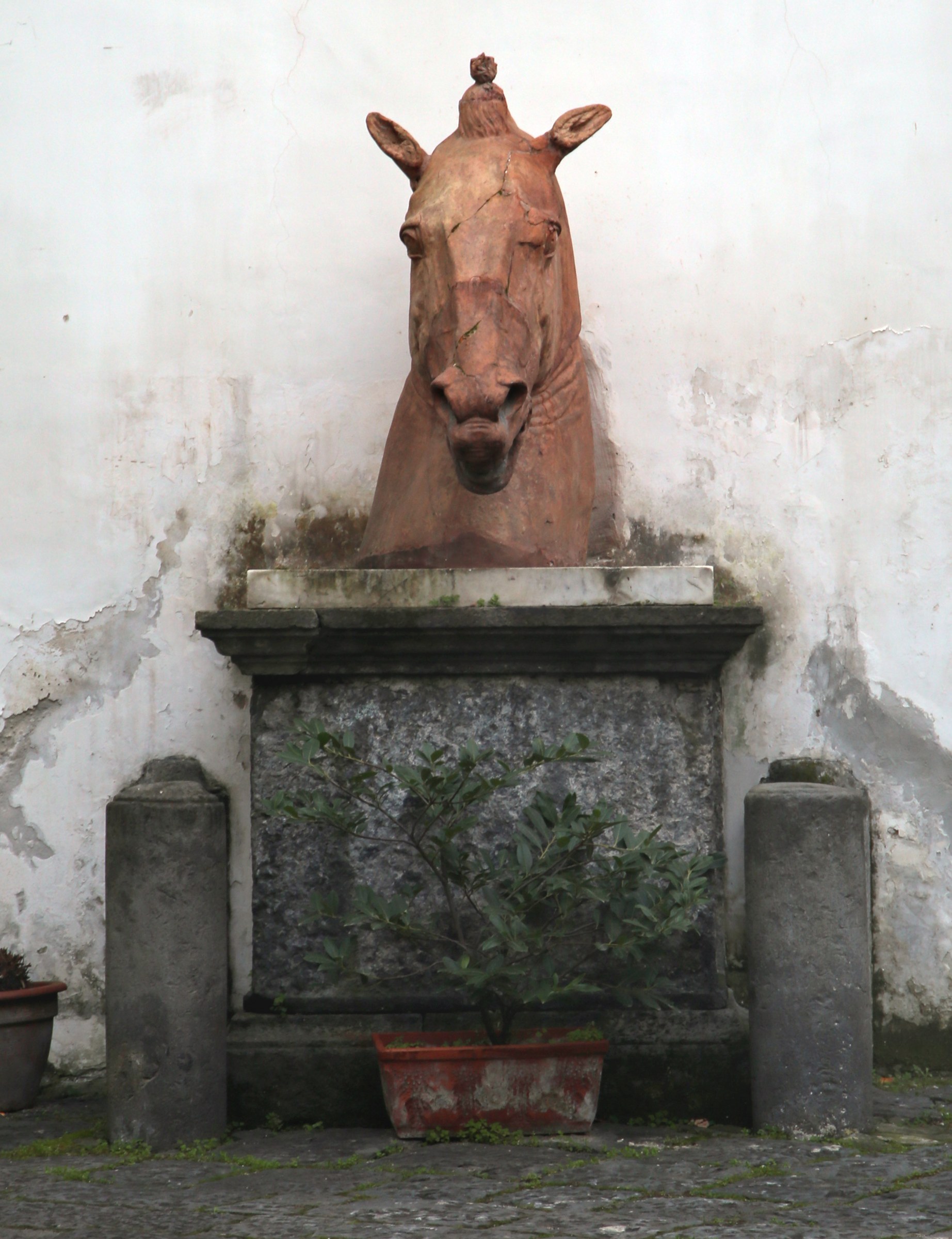
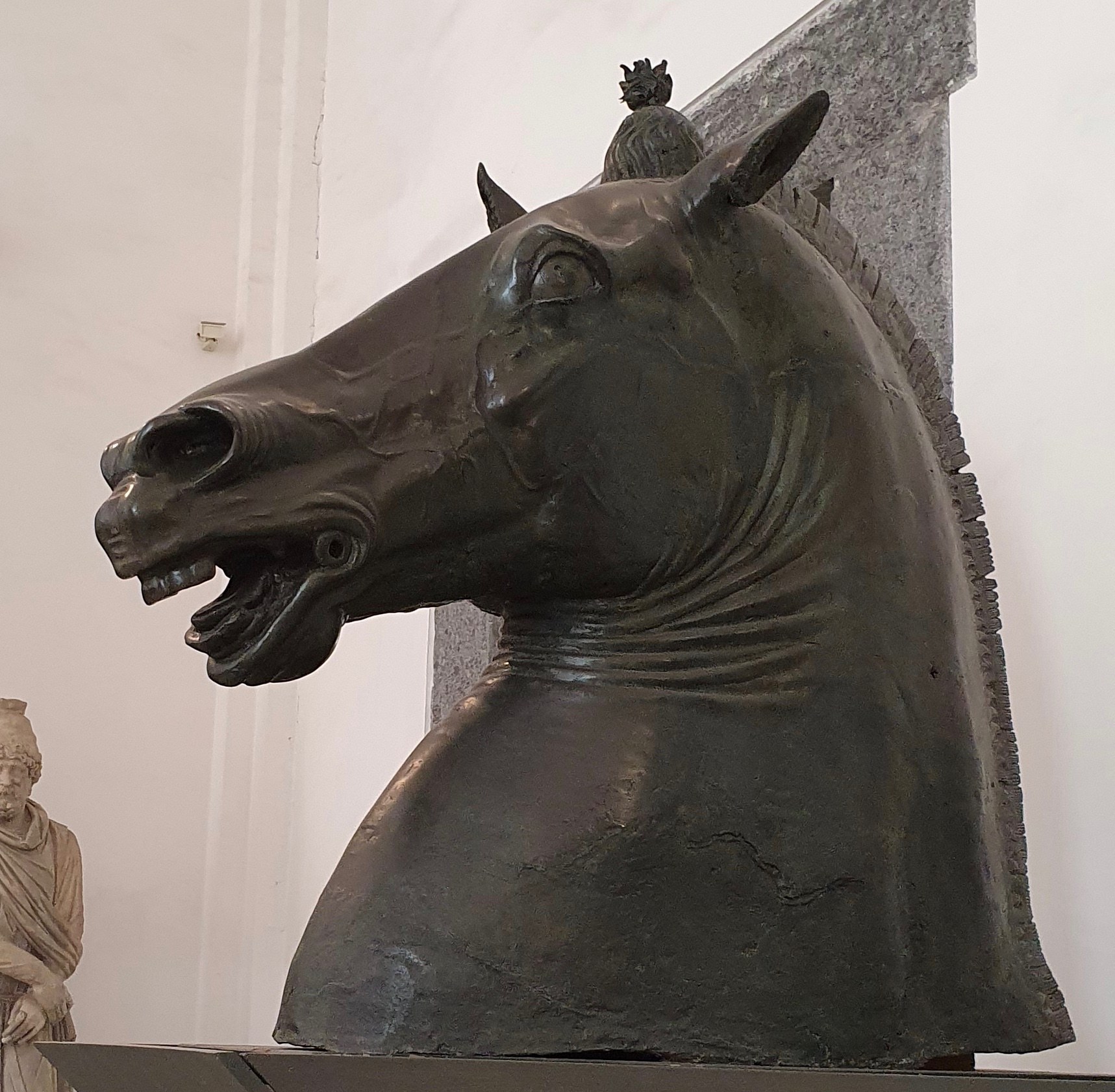
The Palazzo Diomede Carafa in Via San Biagio dei Librai (Spaccanapoli): a terracotta copy stands in the courtyard; the bronze original, the Protome Carafa, is in the National Archaeological Museum of Naples.
Where: Via San Biagio dei Librai 121, 80138 Napoli
Works and documents
AI reconstruction
Sources
J.W. Goethe, Italienische Reise, original German text (public domain).
Translated by A.J.W. Morrison (Goethe’s Travels in Italy, London, Bell; public domain).


