There are days in the Italian Journey when Goethe wins and others when he loses. The day of 2 March 1787 he loses, at least as far as spectacle goes: he climbs Vesuvius in order to see it, but the volcano denies him the sight he was seeking. “On March 2 I ascended Vesuvius, although the weather was gloomy and the summit covered with clouds.”
The first sentence already says it all. Although. The weather was bad, the summit wrapped in cloud, and Goethe climbed all the same. It is not recklessness. It is hunger. Since his arrival in Naples — barely five days earlier — Vesuvius has been the thing he wants to understand before all others. He had seen it from afar, from the carriage, “violently emitting smoke”. Now he wants to stand on top of it.
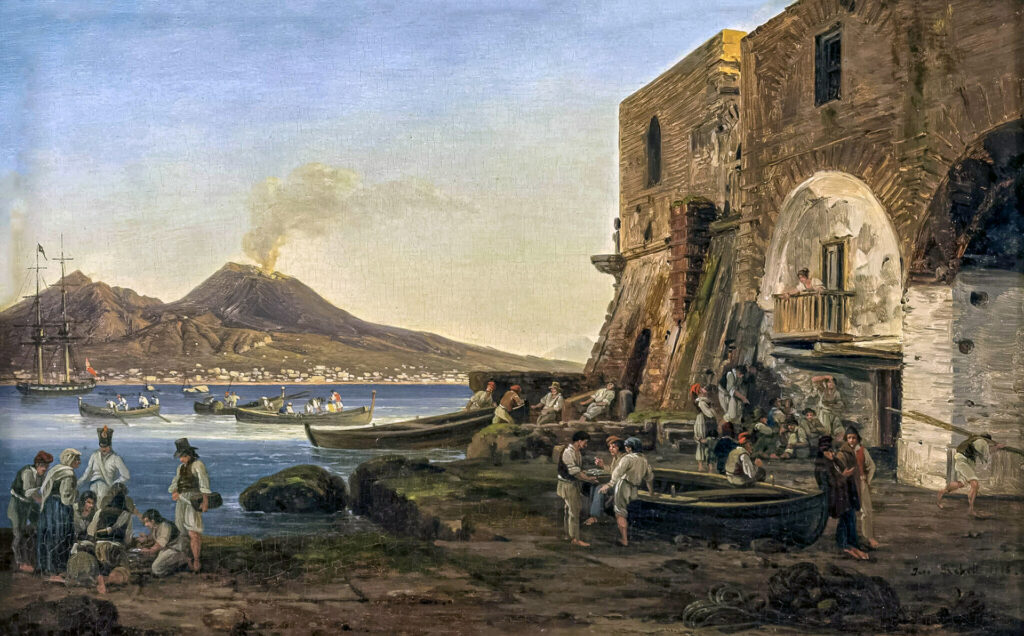
To do so he follows the route every eighteenth-century traveller knew. By carriage as far as Resina — today’s Ercolano — then by mule through the vineyards climbing the flank of the volcano. Those vineyards already produced Lacryma Christi, and they grew on one of the most fertile soils in Europe: decomposed volcanic ash. Vesuvius killed and gave life at the same time. Goethe records it without comment, but anyone who climbs those slopes today, among the same vines, understands at once what he was seeing.
Beyond a certain point one dismounts. One goes on foot.
“next, on foot over the lava from the year ’71, which had already grown a covering of fine but sturdy moss; then up alongside the lava.”
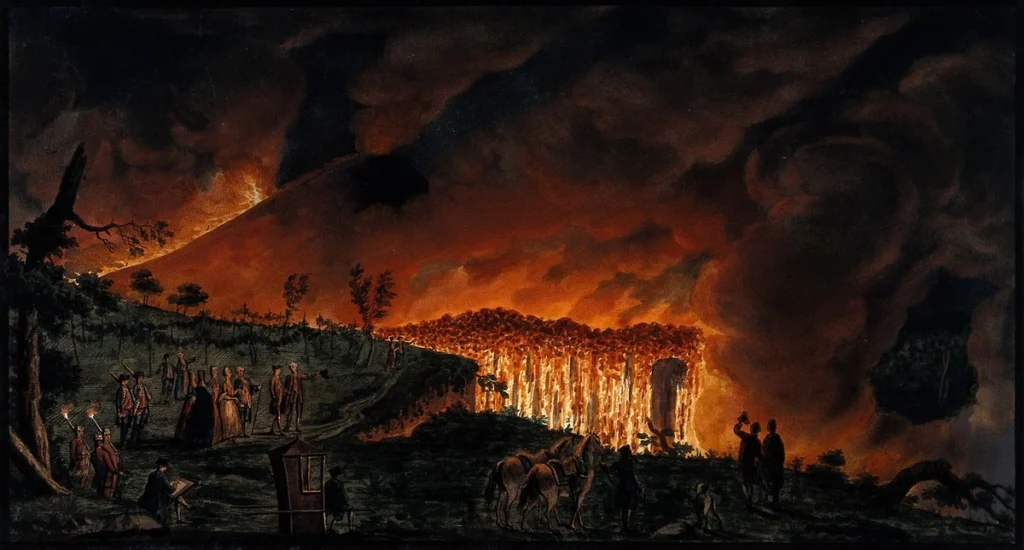
The lava of ’71. Sixteen years earlier. It is the great flow of May 1771, the one that inspired Pietro Fabris to paint the celebrated night view of the lava stream, later published in Sir William Hamilton’s Campi Phlegraei. That lava had descended towards Resina, along the very slope on which Goethe is walking. The moss on the stone means that nature had resumed its work. Sixteen years — and already moss.
There is something vertiginous in this detail, which Goethe registers without emphasis. He is walking on a recent eruption. He walks on living matter, cooled. He walks over a flood of fire turned to stone.
Higher up he passes the hermit’s hut — a Frenchman who would live there for fifteen years. It was a customary stop for travellers. Goethe leaves it “to my left on the heights”, without stopping. He has not come for local colour.
Then begins the great cone of ash.
“Then up the mountain of ashes, which is hard work.”
Anyone who has climbed Vesuvius knows what that means. Every step sinks. For every metre gained, half a metre is lost. The ash gives way under one’s shoes like wet sand. It is the most thankless labour a mountain can impose — not the steep ascent, not the altitude, but ground that will not hold. Hard work — the understatement is exact.
They reach the top. And here the defeat begins.
“Two thirds of this summit was covered with clouds.”
Two thirds. Goethe has reached the top of the cone and sees nothing. The clouds are inside the crater. The mountain is telling him no.
But Goethe does not go down. He looks for another way.
He finds the ancient crater, now filled with recent lavas. He studies them, he dates them: “two months and fourteen days” old. And he also notes “a meager one five days old, already cooled”. He records the dates like an investigator at a crime scene. It is living matter, fresh, still warm until only very recently. Five days earlier — on 25 February — lava was flowing here, while Goethe was entering Naples for the first time.
The volcano and he had arrived at the same appointment, five days apart.
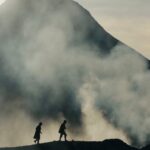
He walks over a hill smoking on every side. The wind drives the smoke in the opposite direction — a stroke of luck, almost an invitation. Goethe seizes it. He wants to see the true crater. He advances.
“We were approximately fifty paces into the smoke when it grew so thick that I could scarcely see my shoes.”
Fifty paces. Then the wind turns. The smoke closes in. Goethe can no longer even see his own shoes. Holding a handkerchief to his mouth is of no use. The guide has vanished into the fog. Underfoot lie “little fragments of lava that had been cast up” — unstable, treacherous.
And here Goethe does something the Romantic poet would not have done. He stops. He turns back.
“I thought it best to turn back and save the desired sight for a sunny day with less smoke.”
I thought it best. No epic, no sublime, no heroic flight. Only the lucid judgement of a man who is learning how one works with a volcano: with prudence. What is more, he adds at once, he has learned how difficult it is to breathe in such an atmosphere. Even defeat is a lesson. Defeat above all is a lesson.
And here is the sentence that changes everything.
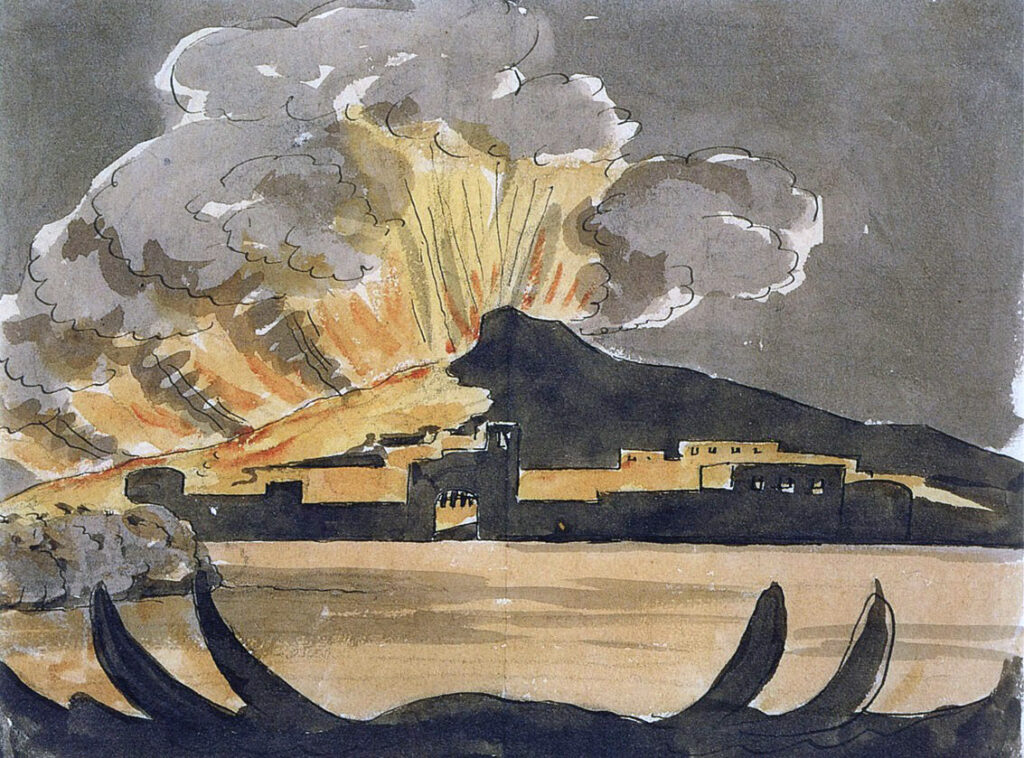
“Now that I have reconnoitered it, I can, so to speak, besiege it as soon as the weather consents to improve.”
Besiege it. In the German: um ihn förmlich … zu belagern — to lay formal siege to it, where the translator’s “so to speak” softens what the original states outright. It is no literary hyperbole: it is a deliberate military lexicon. Goethe no longer speaks as a tourist, nor even any longer merely as a poet. He speaks as a general. Vesuvius has become an adversary — not in a hostile sense, but in a cognitive one. A problem to be surrounded, explored, and finally understood. The first ascent was not a failed excursion. It was a reconnaissance.
In that verb — reconnoitre — something is being born.
From Rome until that moment, Goethe had looked at Italy above all as an artist and a humanist. The ruins, the statues, Raphael’s paintings, the Iphigenia to be reworked. On Vesuvius, by contrast, he looks at a natural phenomenon with a different disposition: he observes, compares, measures, renounces, plans his return. The word “siege” is not emphasis: it is a method.
Goethe will return to Vesuvius twice more: on 6 March, with Tischbein, when he reaches the rim of the crater in the interval between two eruptions and has to flee under a shower of lapilli and ash; and on 20 March, alone, to follow a lava flow towards Ottaviano and walk on the lid of glowing stone that forms over the torrent of fire. Three ascents. Three attempts. Three progressive victories over the same problem. Belagerung — siege — is the exact word.
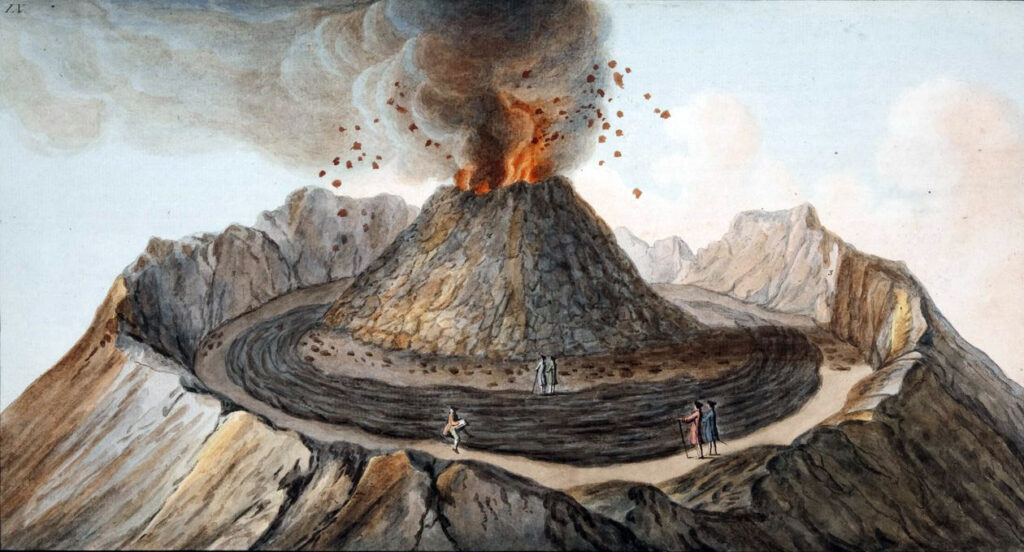
Plate 9 from Campi Phlegraei: Observations on the Volcanoes of the Two Sicilies by Sir William Hamilton, 1776
But there is something more in that first, lost ascent. Something the hasty reader does not see.
Goethe does not come down from the mountain empty-handed. He brings back a hypothesis.
In the last paragraphs of the entry, after recounting the smoke, the retreat, the resolutions, he writes:
“But I discovered a phenomenon that seemed very remarkable to me, and I want to investigate it more closely and get information from experts and collectors.”
It is a stalactitic, greyish coating on what he calls a “volcanic chimney”. And then the sentence that deserves to be read again, slowly:
“I believe that this solid, grayish, stalactitic mineral must have been formed through sublimation of the very most delicate volcanic exhalations, unassisted by moisture and without fusion. It occasions further thought.”
Sublimation of volcanic exhalations. Unassisted by moisture and without fusion. It is a technical proposition. It is a causal hypothesis. It is one of the first moments in the Vesuvian narrative in which Goethe moves from describing the phenomenon to formulating a possible mechanism. Not a mere impression, not an emotion: a proposed explanation of the how.
And it must be said: his intuition was, in principle, remarkably close to the modern explanation. Many fumarolic incrustations do indeed form through the direct deposition of mineral species from hot volcanic gases, without passing through a liquid phase. Goethe could not identify their mineralogical composition with the instruments of later science, but he had grasped the essential point with extraordinary precision: the deposit arose neither from water nor from fusion, but from exhalations.
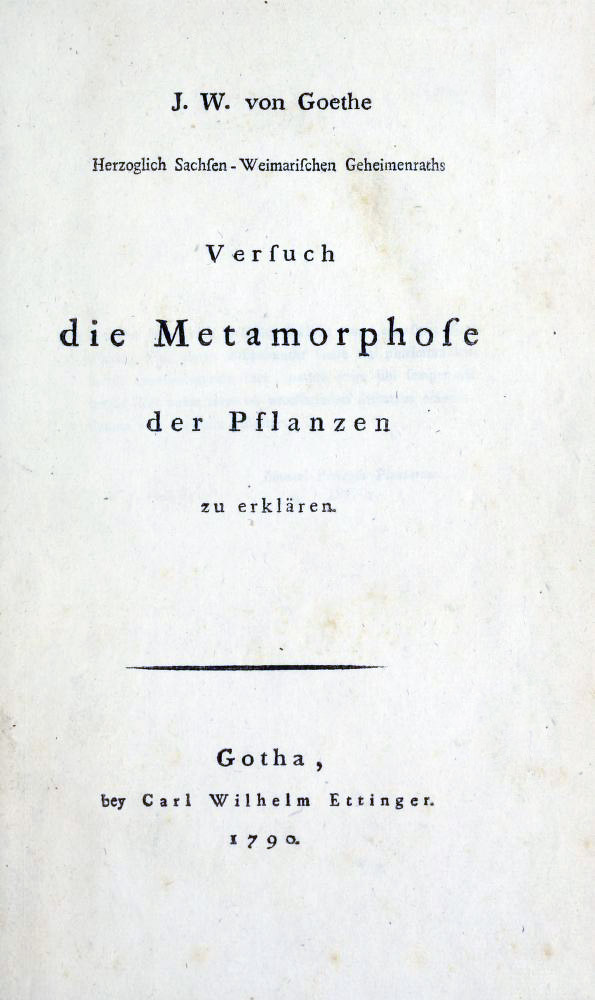
Three years later, in 1790, a small book of 86 pages appears in Gotha, from Carl Wilhelm Ettinger: Versuch die Metamorphose der Pflanzen zu erklären. An essay on the metamorphosis of plants. It will be Goethe’s first independent work of natural science. From then until his death he will write on optics, mineralogy, comparative anatomy, geology, meteorology. The Farbenlehre, the theory of colours, will be the scientific work to which he binds a decisive part of his intellectual identity.
Goethe the scientist is not born here alone. He already has anatomical, mineralogical and botanical interests behind him; and he will be born again elsewhere: in a botanical garden in Padua, in a public garden in Palermo, on the rocks of Paestum. But perhaps here, on Vesuvius, that disposition takes on for the first time an exemplary narrative form: observation, failure, hypothesis, return.
It is born on a cone of ash, amid smoke that robs him of the sight of his own shoes, before a volcano that refuses to show itself. It is born at the exact moment in which a thirty-seven-year-old German poet, defeated by a cloud, decides not to give up and notes — calmly, in an almost cool syntax — that he will lay formal siege to it.
Goethe had not come to Vesuvius only for the sublime. He had come to understand. And when he could not, he organised himself to return.
That is how science is done. That is how, very often, it always has been done.
The Vesuvius of 1787 belonged to the long phase of persistent activity that began after the great eruption of 1631 and ended with the eruption of 1944, which closed that eruptive cycle and profoundly altered the structure of the summit crater. The “hermit’s hut” that Goethe passed stood not far from the spot where, between 1841 and 1845, the Vesuvius Observatory would be built: the first volcanological observatory in the world. Climbing to the terminal cone today, on the way to the crater, one passes it twice.
Sources
J.W. Goethe, Italian Journey, trans. Robert R. Heitner, ed. Thomas P. Saine and Jeffrey L. Sammons, Suhrkamp, New York 1989, entry of 2 March 1787.
J.W. Goethe, Italienische Reise, German reference edition, Hamburger Ausgabe, vol. XI.
J.W. Goethe, Versuch die Metamorphose der Pflanzen zu erklären, Gotha, Carl Wilhelm Ettinger, 1790.
William Hamilton, Campi Phlegraei. Observations on the Volcanos of the Two Sicilies, Naples, 1776.
Pietro Fabris, volcanological views for William Hamilton’s Campi Phlegraei , in particular the depiction of the lava stream of May 1771 towards Resina.
Boris Behncke et al., Vesuvio: Activity from 1632 until 1794, University of Catania, historical-eruptive database.
Roberto Scandone, Lisetta Giacomelli, Vesuvius and Vesuvians: A Geophysical Story, in Journal of Volcanology and Geothermal Research, Elsevier.
H. Frank, entry «Naturwissenschaftliche Schriften», in Goethe Handbuch, J.B. Metzler, Stuttgart, 1996-1997.