The relationship between gesture and time is one of the most fertile vantage points from which to read the transformation of our aesthetic experience between the eighteenth century and the present. The way the hand “fixes” an image – whether a landscape, a work of architecture or a face – conditions not only the form of the result, but also the structure of the time that accompanies it.
In the world of Johann Wolfgang Goethe and Christoph Heinrich Kniep the hand works through slow instruments: pencil, pen, brush, prepared paper, prolonged exposure times. In our present, a large part of visual documentation is entrusted to digital devices that allow almost instantaneous capture and immediate distribution. The comparison between these two regimes of gesture opens a field of reflection that goes beyond nostalgia: it concerns the very form of memory.
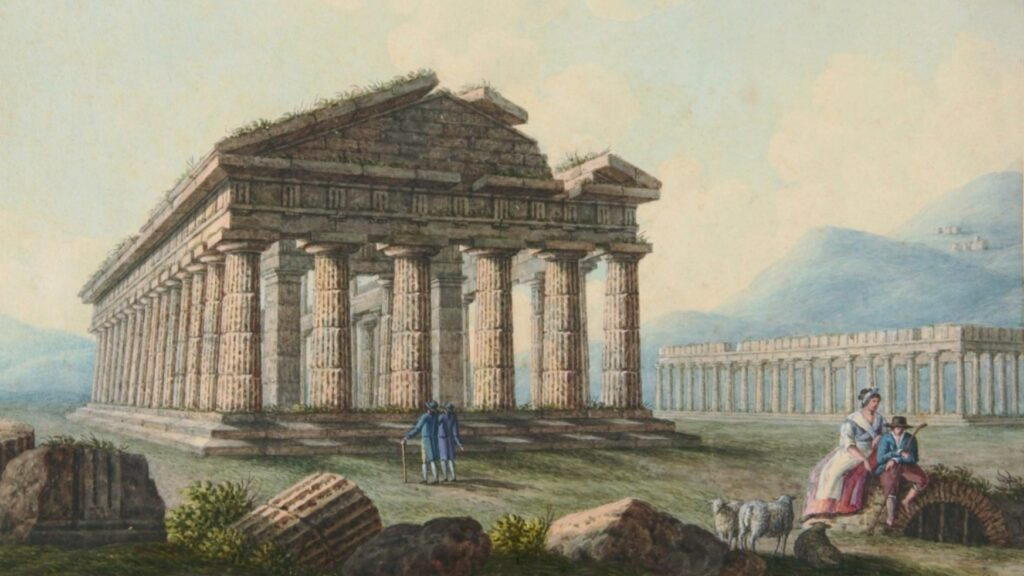
Watercolour (30 x 21.5 cm) – Private collection, Munich
(Provenance: Walter Bareiss Collection)
Recent scholarship has insisted that Goethe is not merely a “poet” contemplating the visual arts, but a profoundly visual subject. From adolescence onwards he takes drawing lessons, watches painters at work, experiments with graphite, pen, watercolour and modelling, accumulating thousands of sheets of landscapes, architecture, anatomical and botanical studies.
Goethe as a Visual Subject
The Italienische Reise (journey 1786–1788, publication 1816–1817) marks a turning point in this trajectory. In Rome, integrated into the community of German and Swiss painters, lodging with Johann Heinrich Wilhelm Tischbein and in contact with artists such as Jakob Philipp Hackert and Angelika Kauffmann, Goethe pushes to the limit his temptation to become a visual artist. He draws daily, takes lessons, tries his hand at sculpture; he even comes to consider abandoning literature for painting, before scaling back this ambition. In a letter from Rome he expresses his limits with self-irony: «Zur bildenden Kunst bin ich zu alt, ob ich also ein bißchen mehr oder weniger pfusche, ist eins».
It is therefore incorrect to imagine Paestum as the “first time” Goethe attempts to fix the world visually or relies on a gesture of graphic documentation. What takes place at Paestum is rather a change of scale: from personal, formative drawing practice to structured delegation to a professional view painter.
Christoph Heinrich Kniep in the Context of the Grand Tour
Christoph Heinrich Kniep (Hildesheim 1755 – Naples 1825) belongs to that constellation of German artists who, between the late eighteenth and early nineteenth centuries, turned Italy into a laboratory of landscape and ruin. Initially trained as a portraitist in Germany, thanks to the support of the bishop and writer Ignacy Krasicki he was able to move to Italy in 1781; he settled in Rome and then in the Naples area, where the combination of sea, volcano and Graeco-Roman archaeology offered ideal material for his views.
Current research emphasises the almost “documentary” quality of his works: the views of Paestum, Pompeii and the Neapolitan countryside show meticulous attention to proportions, terrain morphology and architectural detail, to the point of being useful for the history of archaeology as well. The exhibition “L’Italia in linee. Disegni di Christoph Heinrich Kniep” at the Casa di Goethe (Rome, 2025–26) and its catalogue have consolidated this reading, presenting Kniep as a visual mediator between the experience of the Grand Tour and the iconographic stabilisation of landscape.
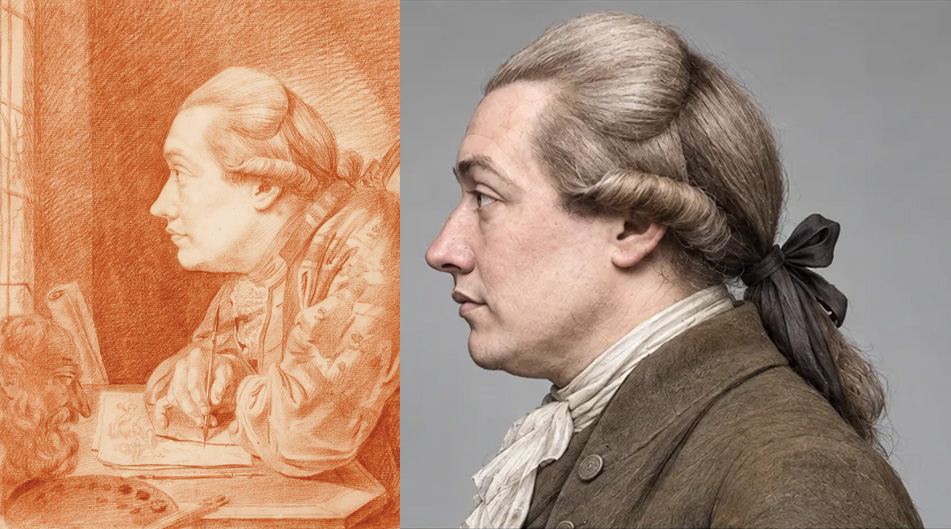
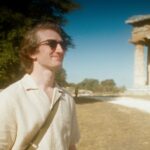
Right: reconstruction of the face of Christoph Heinrich Kniep by SPUN.ai © 2026
The First Meeting of Goethe and Kniep: Naples 1787
The sources agree in placing the first meeting between Goethe and Kniep in Naples in 1787, within the network of artistic relationships surrounding Tischbein. Goethe, who had left Weimar in September 1786, reached Rome in October, stayed there until February 1787, then continued to Naples (25 February) and from there to Sicily. It is in this context that, on the recommendation of Tischbein and other artists of the German circle, he learns of Kniep’s abilities as a landscape painter.
The decision to involve him systematically was taken shortly before, or at the time of, the excursion to Paestum. In the journal and its later reworkings Goethe describes the passage from a mere acquaintance to a “practical” relationship: Kniep is no longer just an artist met in a circle of friends, but a collaborator entrusted with a precise function, with a commission, a fee and defined rules.
Paestum: Aesthetic Experience and the Contract of the Gesture
The visit to Paestum is a pivotal moment. On Goethe’s side, it offers one of the most studied cases of a “conversion of the gaze”: the initial impact of the three Doric temple masses – squat, closely spaced columns, proportions far removed from the neoclassical canon – produces a sense of dismay that scholars have related to the eighteenth-century debate on the “disproportion” of Paestum.
The poet moves from a perception of oppression to a form of familiarity: he reactivates his knowledge of art history, places the temples in an archaic context, interprets them as evidence of an earlier stage of the classical form; the architecture ceases to appear “monstrous” and becomes the laboratory of his own aesthetic transformation. The Italienische Reise records this shift with great lucidity, and recent historiography regards it as a paradigmatic example of the encounter between the modern subject and the classical “primitive”.
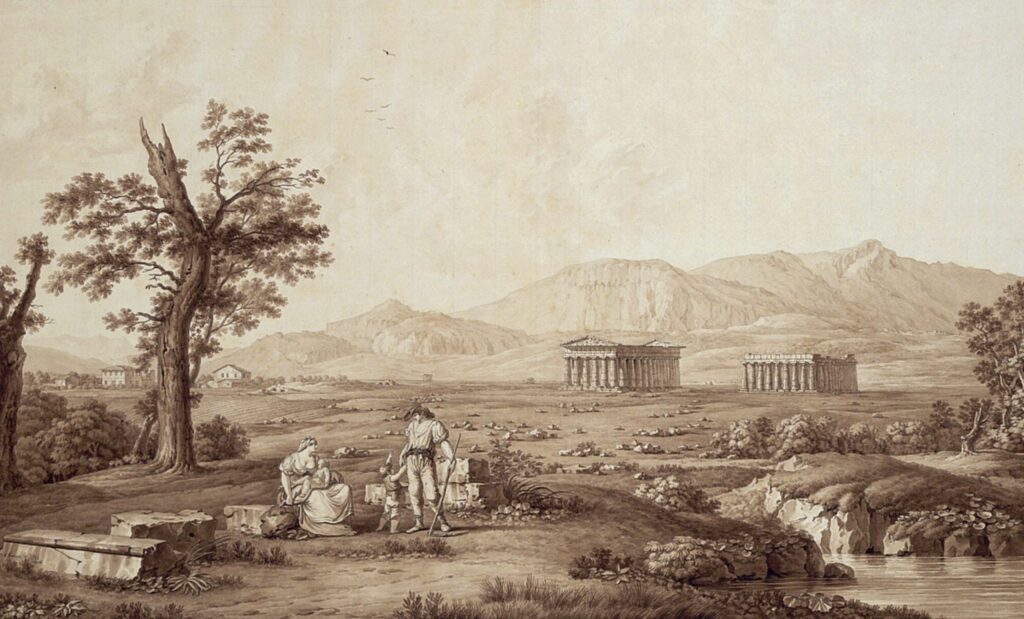
Blickling Hall Collection, Norfolk, United Kingdom
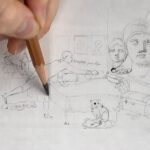
On Kniep’s side, Paestum is the place where a genuine economy of the gesture takes shape. Goethe describes the draughtsman’s modus operandi with precision: framing the sheet with a rectangle, the use of “the best English pencils”, the almost ritual habit of sharpening them again and again. Above all, he establishes an agreement: all the Umrisse (outlines, sketches of landscape and ruin) will be Goethe’s property; after their return, Kniep will work up some of the views in sepia or watercolour, for a fee set according to the quality and importance of the subjects.
In theoretical terms, Paestum shows the convergence of two gestures: that of Goethe, who takes upon himself the task of working through the experience in discursive and poetic form, and that of Kniep, who establishes a stable protocol for the graphic translation of landscape.
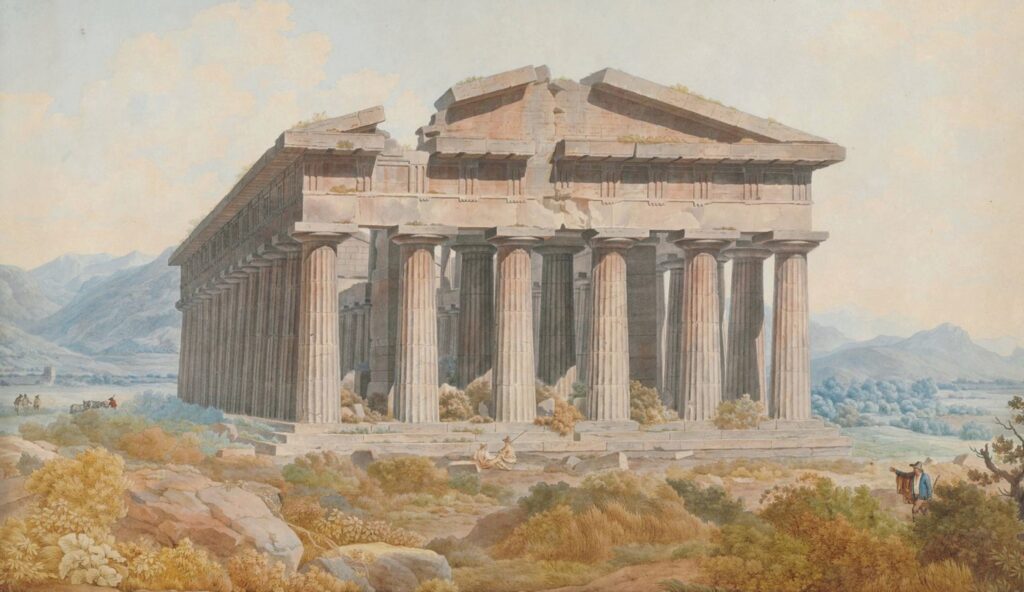
Klassik Stiftung Weimar, Bestand Museen, Germany
Delegating the Gaze: Goethe between Drawing and View Painting
The decision to “engage” Kniep should not be read as Goethe’s complete renunciation of drawing, but rather as a redefinition of roles. Throughout the Italian journey the poet continues to draw, as the surviving albums and sheets demonstrate, comprising landscapes, architectural motifs and studies from nature. The collaboration with Kniep arises from the recognition of a limit: Goethe understands that, for an accurate graphic documentation of the journey – especially in territories such as Sicily – his own level of skill is not enough; a landscape painter is needed to stabilise visually what he, as writer and observer, is passing through.
Paestum thus becomes a “case study” of the transition from amateur artistic practice to professional delegation. Goethe does not stop looking, but concentrates his energy on interpretation, writing and theoretical elaboration; Kniep takes on responsibility for topographical fidelity and for building up a corpus of views. The memory of the journey is constructed as a double helix: texts and drawings.
The Contemporary Gesture: Speed, Sedimentation, Memory
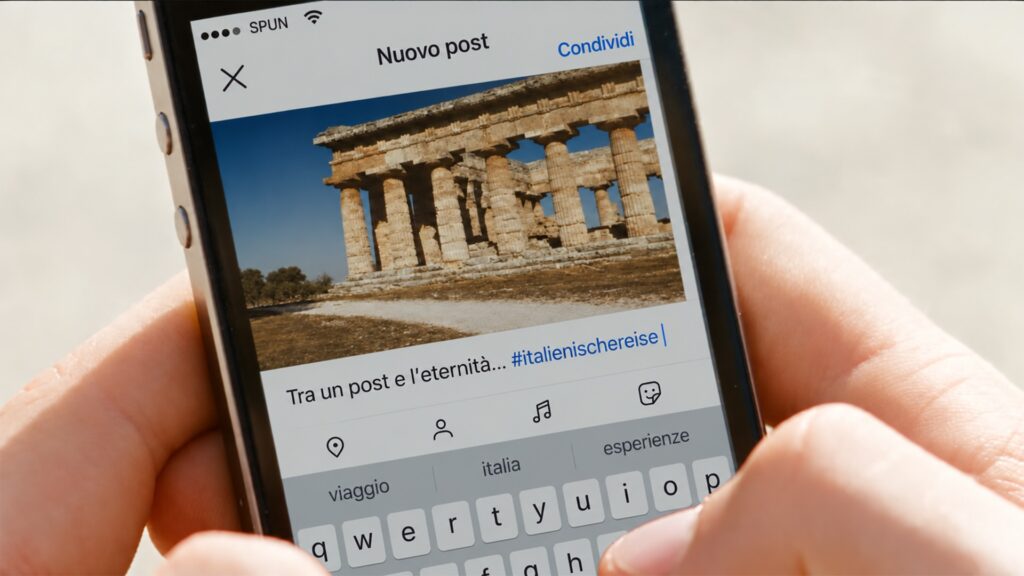
If a contemporary device – a smartphone, a digital recording system – is introduced into this scene, the structure of the gesture changes radically. The time of capture shrinks: a video or a photograph can fix in a few instants what Kniep takes hours to translate into lines; distribution shifts from the slow circuit of prints, albums and catalogues to the immediate one of social media and sharing platforms.
From an essayistic point of view, the point is not to set slowness and speed against each other in moral terms, but to observe the effects on the process of sedimentation. In the Goethe–Kniep model, memory is deferred: it arises from the combination of diary notes, later reworkings (the Italienische Reise was only fully written up decades later) and the graphic corpus produced during the journey. In the contemporary model, memory tends to coincide with the first capture: image, video and caption are already “narrative” at the very moment of the gesture.
The risk, in terms of experiential depth, is that the phase of “conversion of the gaze” – that shift from surprise to familiarity which Paestum exemplifies – is compressed or replaced by the immediate gratification of publication. The historical case does not invite us to reject technology, but to ask which slow gestures are worth preserving within a fast system.
What Has Changed in the Gesture
Chronologically, the answer to the question “how many years have passed?” is simple: more than two centuries lie between 23 March 1787 and our present. Aesthetically and anthropologically, the answer is more complex: in the meantime the way we measure the time of experience has changed, as has the way we articulate gesture, vision and memory.
The comparison between Goethe–Kniep and the contemporary gesture highlights at least three differences: the different duration of the gesture (hours of sitting and work vs. seconds of capture), the different temporality of memory (deferred and stratified vs. immediate and often ephemeral), and the different distribution of roles between observer and producer of images (poet-draughtsman + landscape painter vs. a subject who often coincides with author, director and distributor of their own content).
In this framework, the case of Kniep – and Goethe’s decision to rely on him – continues to offer a discreet lesson: slowness is not a value in itself, but a condition that allows the world to “teach” its own forms. The contemporary challenge lies in finding spaces in which the gesture, even when it makes use of fast devices, grants time enough margin to accomplish that transformation of the gaze which, at Paestum, took “less than an hour”.
NOTES:
«Zur bildenden Kunst bin ich zu alt, ob ich also ein bißchen mehr oder weniger pfusche, ist eins.» Translation: “I am too old for the visual arts, and so it does not matter how much, or how little, I botch things.” (trans. Robert R. Heitner). Letter from Rome of 6 February 1788, in Italienische Reise (Second Roman Sojourn) and in the critical editions of the Italian letters. [projekt-gutenberg][litwiss-online.uni-kiel][litwiss-online.uni-kiel][goethezeitportal]
SELECT BIBLIOGRAPHY:
Johann Wolfgang Goethe, Italienische Reise, various editions (German editions and translations); English quotations from Italian Journey, trans. Robert R. Heitner, Suhrkamp, New York 1989.[gutenberg][de.wikipedia]
Johann Wolfgang Goethe, Briefe. 18. September 1786 – 10. Juni 1788, ed. V. Giel, Berlin 2012.[litwiss-online.uni-kiel]
Goethezeitportal, “Goethe als bildender Künstler”, “Goethe: Zeichnungen aus Italien”.[goethezeitportal][goethezeitportal]
Goethezeitportal, “Christoph Heinrich Kniep”, with biographical profile and analysis of his journeys in Italy.[goethezeitportal]
Casa di Goethe (Rome), L’Italia in linee. Disegni di Christoph Heinrich Kniep, exhibition catalogue.[casadigoethe][casadigoethe]
Joselita Raspi Serra (ed.), La fortuna di Paestum e la memoria moderna del dorico 1750‑1830, 2 vols., Florence 1986.[iconografiacittaeuropea.unina][zobodat]
Studies on the Italienische Reise and Paestum: J. Busch, «Unklassische Italienreisen» (2010); contributions on the eighteenth-century debate on the “disproportion” of the temples of Paestum.[journal.eahn][archiv.ub.uni-heidelberg]