Some pages of the Italian Journey seem marginal and are not. A handful of lines in all. An afternoon visit to a painter, a walk by the sea, a few strange fish drawn from the waves. The day was splendid, the tramontane bearable.
“Today we visited Philipp Hackert, the famous landscape painter, who enjoys the special confidence and most particular favor of the king and queen. They have assigned him a wing of the Francavilla palace, which he has had furnished with artistic taste and lives in contentedly.”
“He is a very resolute, intelligent man, who knows how to combine incessant hard work with enjoyment of life.”
A single sentence, the last one. It reads like a memorandum. It is in fact the answer to a question Goethe had been asking himself for months.
To grasp the weight of that encounter one needs to know who Hackert was in February 1787.
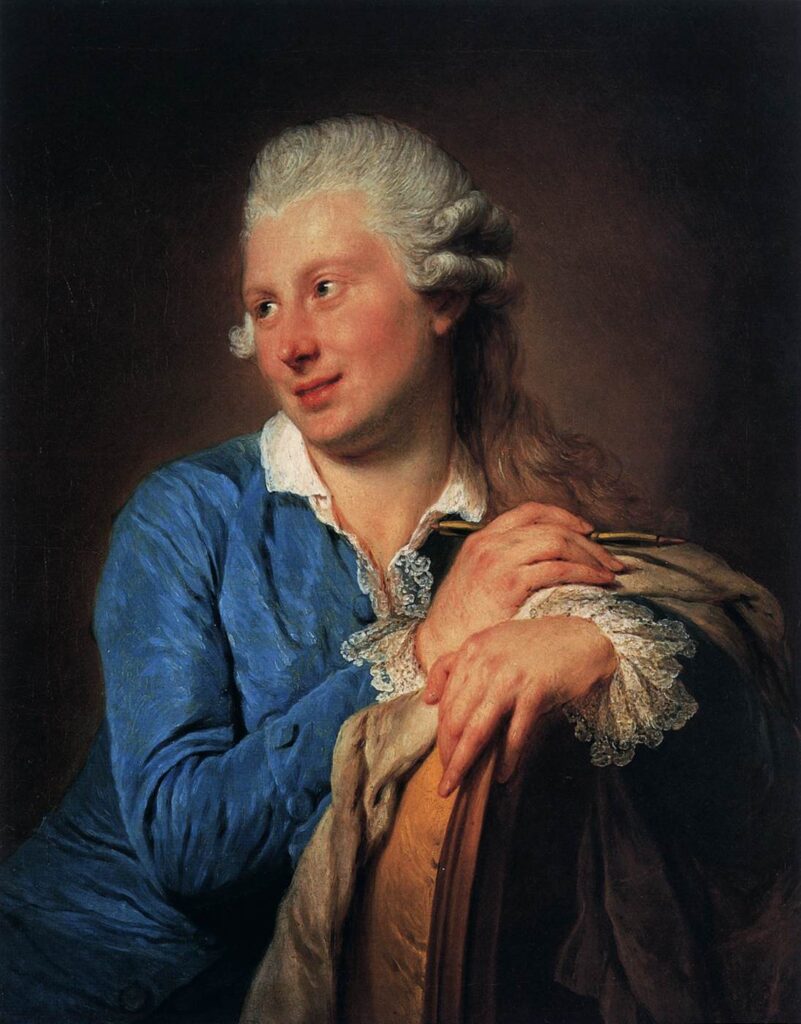
Jakob Philipp Hackert is forty-nine. He was born in Prussia, at Prenzlau, into a family of painters. He studied in Berlin and passed through Paris, where he met Claude-Joseph Vernet — the great French landscape painter — and learned the lesson that would change his life: to paint from nature. He has lived in Italy since 1768. For almost twenty years he was in Rome, where he became the point of reference for the landscape painters from the North — French, German and Dutch artists who, in the wake of Claude Lorrain, Poussin and Dughet, populated the Eternal City. In 1786 he moved to Naples, summoned as court painter by Ferdinand IV of Bourbon.
Goethe knows him even before he meets him.
In Rome, in the autumn of 1786, he had taken part in the Frascati gatherings: artists and amateurs who met in the evening, laid on the table the sheets drawn during the day and discussed them. That system — practical, communal, almost artisanal — had been devised by Hackert. Aulic Councillor Reiffenstein had inherited it after his move to Naples. “This laudable society was actually founded by Philipp Hackert,” Goethe would write, “who could draw and finish the real views in a very tasteful fashion.” When, on 28 February, Goethe crosses the threshold of the Palazzo Francavilla on the Riviera di Chiaia, he is meeting a man who, without knowing it, had already taught him something.
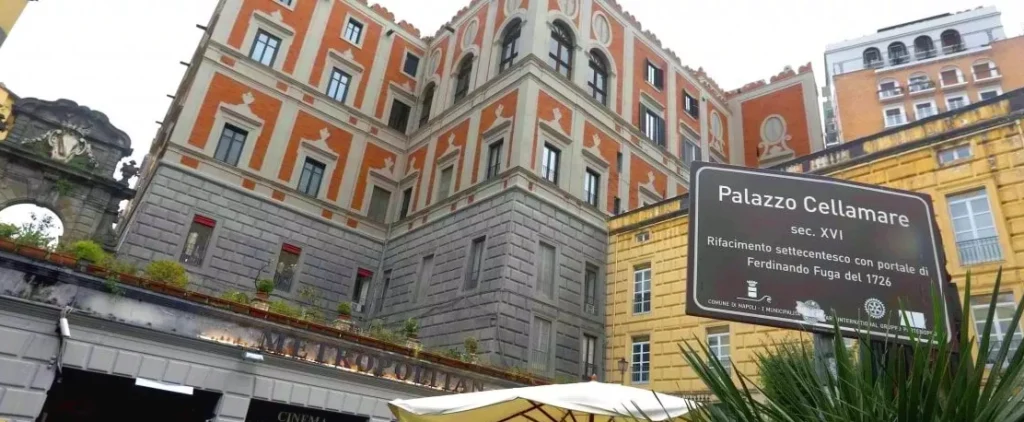
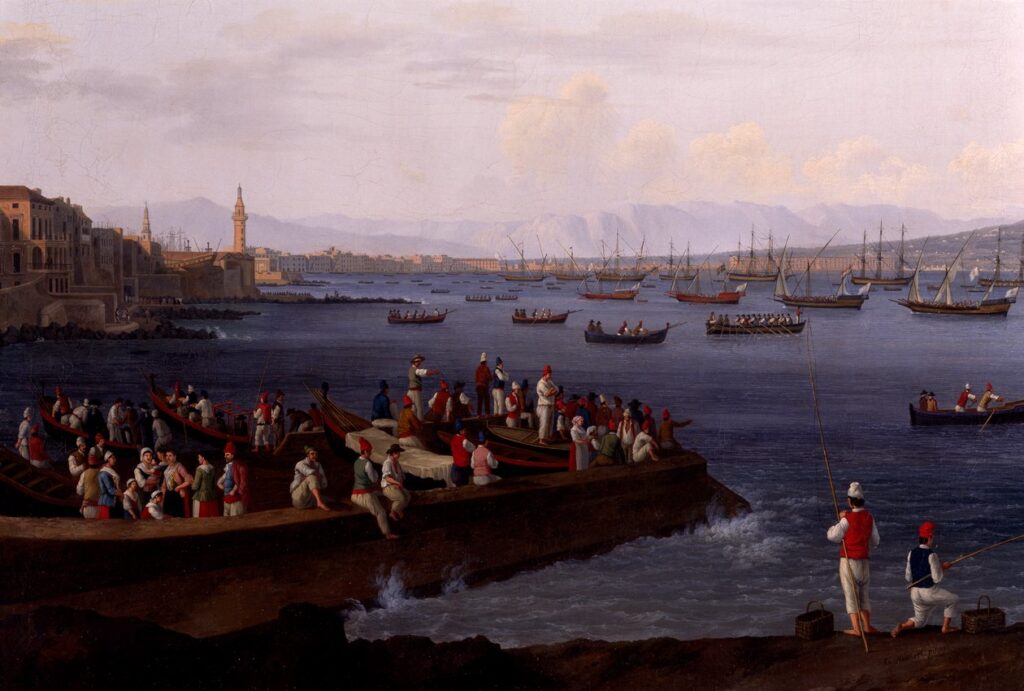
The Palazzo Francavilla is one of the finest aristocratic residences in Naples. Built in the sixteenth century and enlarged in the eighteenth, it is known today as Palazzo Cellamare. Hackert has an entire wing at his disposal. The journal notes — with a gentleman’s restrained envy — that the painter has had it “furnished with artistic taste” and lives in it “contentedly”. In plain terms: he lives well. A royal salary, a house befitting his station, a privileged relationship with King Ferdinand IV and Queen Maria Carolina. He gives drawing lessons to the princesses. In the evening he is invited to court for conversations on art. He is working without respite on the series of the ports of the kingdom — an enormous commission modelled on Vernet’s in France, now preserved at Caserta — and on the Four Seasons for the hunting reserve at Fusaro, which he would consider his major work.
And he is happy.
That is the point. Goethe is not used to it. Goethe comes from a German court where he served Duke Karl August as Geheimer Rat, overseeing mines, roads and finances, and felt himself suffocating. He had fled. He had left Weimar in secret, entered Italy under an assumed name, and travelled as Philipp Müller. Fleeing the court had been his way of saving the artist within him.
Hackert stayed at court. And saved himself all the same.
“He knows how to combine incessant hard work with enjoyment of life.”
Naples, 28 February 1787
This is no neutral description. It is a programme. In Hackert Goethe sees the man who has done what he himself does not yet know whether he can do: hold together two things that seemed mutually exclusive. German rigour and southern sweetness. Work and joy. Service and freedom.
Hackert works incessantly. The same note returns two weeks later, when Goethe sees him again at Caserta: “he is always busy drawing and painting”. He is no dilettante who indulges in art as a pastime — he is a professional who produces, every day, panel after panel, landscape after landscape. And yet he is not grey, not bitter, not obsessive. He knows how to enjoy life. He knows how to move at court. He knows how to be affable. He knows, as Goethe would write shortly afterwards, how “to attract people by making each one his pupil”.
In German terms, Hackert is the very opposite of the young Sturm und Drang type — the titanic, solitary, rebellious artist. He embodies another model: the artist as a cultivated craftsman, integrated into society, productive, serene. It is the model Goethe is beginning to desire for himself. The flight to Italy will not end in a final farewell to Weimar — it will end in a return, and in a new arrangement: less administration, more art and science, but always within the court. Hackert is the prototype of that arrangement. Goethe looks at him and understands that it can be done.
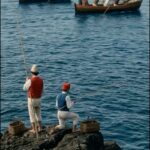
The afternoon does not end in the palace. Hackert takes them down to the sea to watch the fishermen. “We saw all sorts of fish and curiously shaped creatures pulled from the waves.”
An apparently decorative sentence. In reality it is one of the small miracles of the Italian Journey. Goethe has been in Naples for three days. In forty-eight hours he will climb Vesuvius for the first time. In three weeks he will be at Paestum. Seven weeks later, in a garden in Palermo, the intuition of the Urpflanze, the primal plant, will come to him. Goethe the scientist, Goethe the naturalist, the Goethe of botany and volcanism — is being born in precisely those days.
And he is born, symbolically, in Hackert’s company.
For Hackert already was what Goethe was about to become: an exact observer of the real. Not a dreamer of ideal landscapes — a punctilious, scientific draughtsman, who wanted plants and trees to be botanically correct and places to be recognisable at first glance. When, two weeks later at Caserta, Hackert tells Goethe his most famous sentence — “You have talent, but you cannot do anything” — it will not be merely a criticism of his drawing. It will be the handing over of a method. Precision in drawing, sureness and clarity in the disposition of light and shadow. The three rules that held for the brush would soon hold for Goethe’s eye upon the whole of nature.
The fish drawn from the waves on that first evening are already a lesson. Hackert looks at them as a painter. Goethe will learn to look at them as a naturalist. But the gesture is the same: to bend over the real and take its measure.
Twenty years later, on 28 April 1807, Hackert dies on a small estate near Florence, San Piero di Careggi, where he had taken refuge after fleeing Naples during the Parthenopean Republic of 1799. He leaves precise instructions: his autobiographical notes are to go to Goethe.
The papers reach Weimar on 5 June. Goethe reads them on the 7th and 8th. As early as 29 and 30 June he publishes a first excerpt in the Morgenblatt für gebildete Stände. Four years later, in 1811, the complete volume appears in Tübingen from the press of J.G. Cotta: Philipp Hackert. Biographische Skizze, meist nach dessen eigenen Aufsätzen entworfen — a biographical sketch, largely drawn from his own writings.
It is the only book Goethe ever devoted to the life of another artist. Not to Winckelmann, not to Tischbein. To Hackert.
In that choice, posthumous and silent, lies the meaning of that afternoon of 28 February 1787. Goethe had not met a painter. He had met a possibility of life. And he repaid it, twenty years later, with the gift a writer can make to a dead friend: to remember him in writing.
The Palazzo Francavilla still stands on the Riviera di Chiaia. Today it is called Palazzo Cellamare. No plaque records that the German painter of a Bourbon king lived there, or that one February afternoon in 1787 a traveller incognito, who went by the name of Müller, climbed its stairs. The Riviera di Chiaia is still beautiful. And the fishermen, now and then, still draw curiously shaped creatures from the waves.
Sources
J.W. Goethe, Italian Journey, trans. Robert R. Heitner, ed. Thomas P. Saine and Jeffrey L. Sammons, Suhrkamp, New York 1989 (entries of 15 November 1786, 28 February and 14-16 March 1787)
J.W. Goethe, Philipp Hackert. Biographische Skizze, meist nach dessen eigenen Aufsätzen entworfen, J.G. Cotta, Tübingen 1811
W. von Löhneysen, entry «Hackert, Philipp» in Neue Deutsche Biographie 7 (1966), pp. 410-411
Wolfgang Krönig et al., Jakob Philipp Hackert. Der Landschaftsmaler der Goethezeit, Köln-Weimar-Wien 1994
Claudia Nordhoff, Jakob Philipp Hackert 1737-1807. Verzeichnis seiner Werke, 2 vols., Berlin 1994
H. Frank, entry «Philipp Hackert» in Goethe Handbuch, ed. B. Witte and P. Schmidt, J.B. Metzler, Stuttgart 1997