Naples, March 1787. Goethe has been in the city for some ten days, and happiness is everywhere. Not the happiness of philosophers — that of the senses. Vesuvius smoking, markets shouting, full-moon nights on the Chiaia seafront where — he notes — “a feeling of the infiniteness of space really comes over one”. After Rome, where everything is “very solemn”, Naples is its opposite: “here all is merry and gay”. Even the churches seem made for amusement. A Capuchin paces up and down a pulpit as wide as a gallery, reproaching the faithful “for their sinfulness” with the air of a man on stage.
It is a happiness that needs no justification. It simply exists.
And then Goethe meets a man who, on the contrary, wants to found happiness.
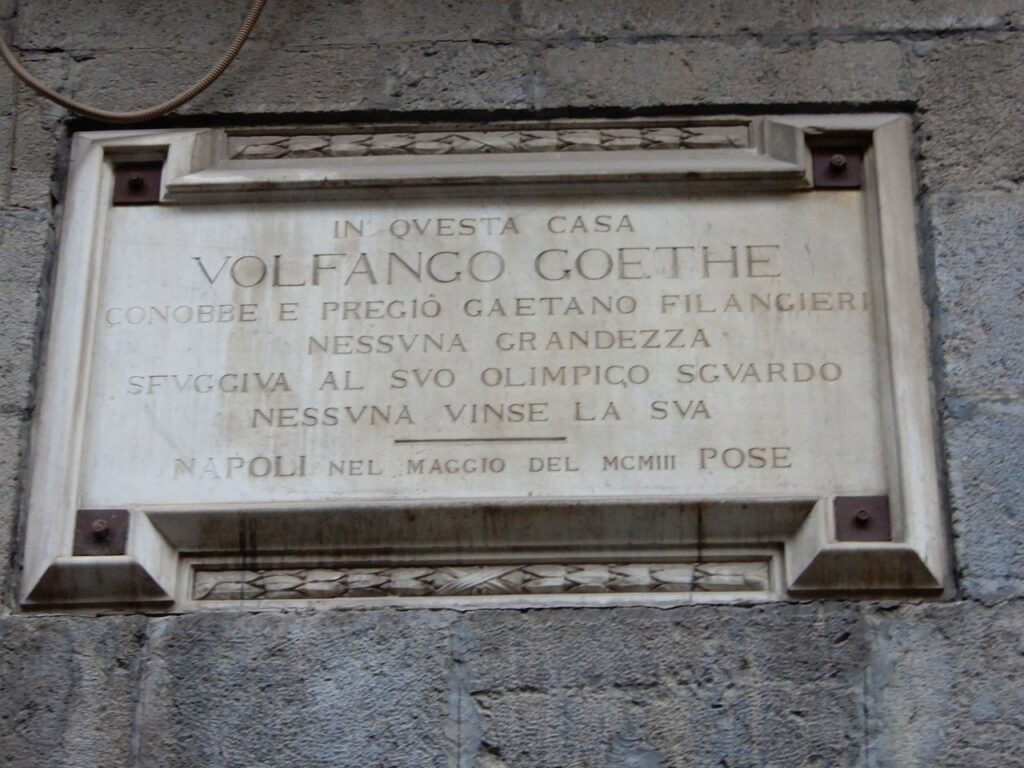
He introduces him with a certain caution, almost in passing. “I must briefly, and in a very general way, mention an excellent man with whom I have become acquainted in the last few days. He is Cavaliere Filangieri, known for his book on legislation.” This is not the opening of a heroic portrait. It is the tone of private correspondence — that of someone who does not wish to exaggerate yet cannot remain silent.

Then comes the decisive sentence: “He is one of those noble young men who work for the happiness of human beings and their honorable freedom.”
Happiness. Not well-being, not progress, not public order. Happiness. In Goethe’s German the word is Glück — which means both happiness and good fortune, as though the two were inseparable. But for Filangieri happiness is not fortune. It is a project. The entire Scienza della Legislazione — whose publication began in 1780 — rests on an idea that sounds obvious today but was explosive in the eighteenth century: laws do not exist to preserve power, but to produce happiness. “Good laws are the sole support of national happiness,” Filangieri writes. And that national happiness is no abstraction: it is the sum of the happiness of individual citizens. Every individual counts. Every person has a right to fare well.
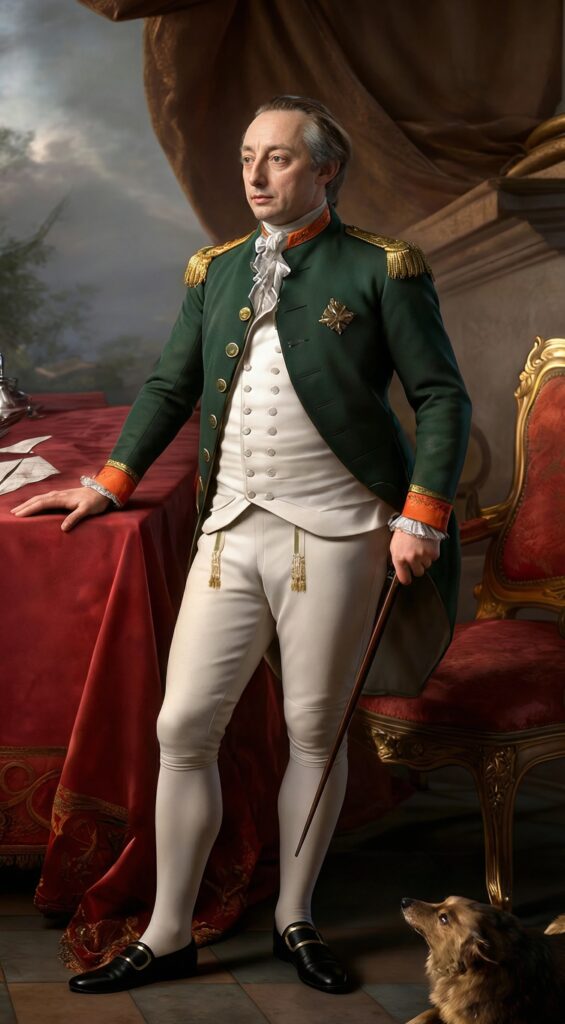
Gaetano Filangieri is thirty-four. He is a nobleman, a Neapolitan, already famous throughout Europe — in 1787 probably more so than Goethe himself. The Scienza della Legislazione has been translated into French, Spanish, German and English. Benjamin Franklin owns two copies in his personal library and corresponds with him directly — while on the other side of the ocean a Constitution is being written that will place in its preamble the pursuit of happiness, the right to seek happiness. It is no coincidence. Filangieri’s ideas cross the Atlantic before he does.
And yet he lives in Naples, in the ancestral palace at Largo Arianiello, in what Goethe, a few days later, will describe as living “respectably but modestly”. He is not a rich man. He is a man who thinks on a grand scale.
What strikes Goethe is not the fame. It is the bearing.
“His deportment bespeaks the soldier, the cavalier, and the man of the world, yet this correctness is tempered by the fine moral feelings expressed in his whole personality and very charmingly evident in his words and ways.”
It is an exact portrait. Filangieri is not the abstract intellectual reasoning in the void. His ideas inhabit the body, issue from the voice, can be read in the way he shakes a hand or chooses his words. Goethe — who is a connoisseur of physiognomies — recognises something rare: thought become presence. As though the happiness Filangieri theorises in his books were already written upon him.
Then comes the political man.
Filangieri is “sincerely committed to the king and his kingdom”, but he does not approve of everything that happens in the realm. And there is something that truly frightens him: the shadow of Joseph II of Austria, whom many in Naples fear to have designs on Italy. “The image of a despot, even though it may still be just hovering in the air, is terrible to noble-minded persons.”
The despot is the exact opposite of Filangieri’s happiness. The despot decides for everyone. Happiness, by contrast, belongs to individuals — and it is just laws that protect it. That is why Filangieri speaks to Goethe “quite candidly” about what Naples has to fear. It is not fear. It is lucidity.
He discourses on Montesquieu, on Beccaria, on his own works. Always, Goethe notes, showing “the same best intentions and the same warm youthful desire to accomplish good”.
That word — youthful — is not incidental. Filangieri is thirty-four and reasons as though the world were still entirely to be built. The good to be done, happiness to be founded. Not as utopia but as engineering: law by law, article by article.

Then Vico arrives.
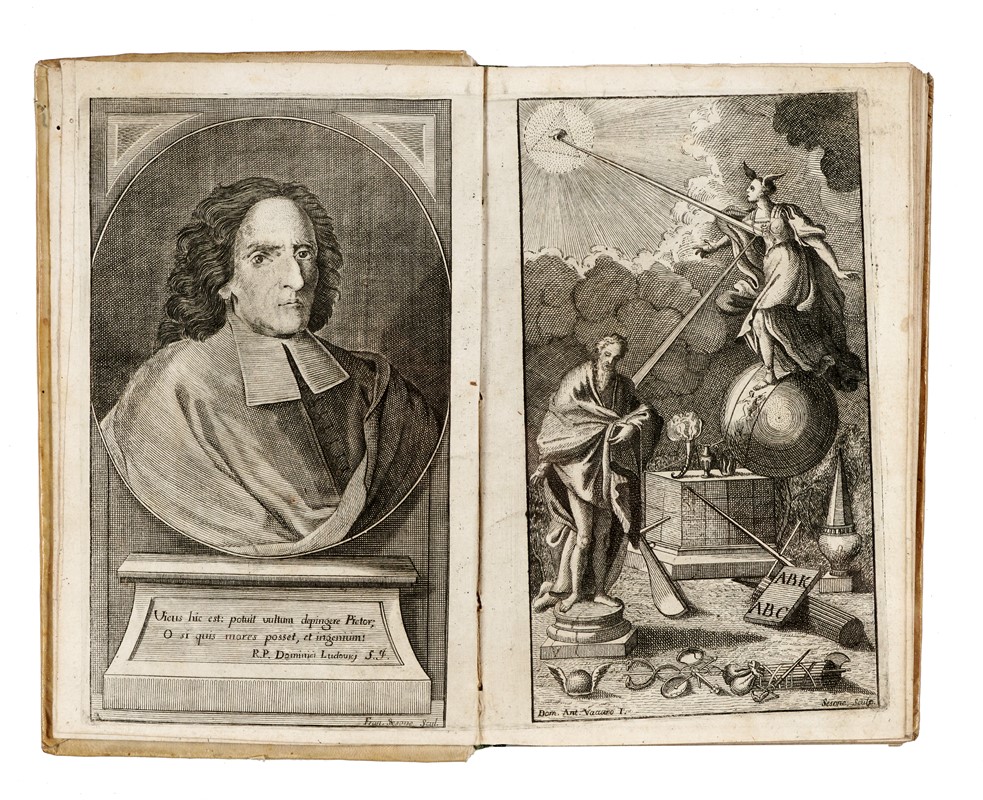
At a certain point in the conversation Filangieri introduces a name: Giovan Battista Vico — a Neapolitan philosopher of the previous century, at that time virtually unknown outside Italy. His Scienza Nuova, published more than sixty years earlier, still has no German translation — it will have none until 1924, the work of Erich Auerbach. And yet these “modern Italian devotees of law” rank him above Montesquieu. The book is handed to Goethe “as a holy relic”.
Goethe leafs through it. He takes away an oblique impression: he glimpses in it “sibylline presentiments of a goodness and justice which would or should come some day, presentiments based on a serious contemplation of life and traditions.” He does not, perhaps, understand everything. But he understands the gesture. Filangieri is not only a cosmopolitan man of the Enlightenment with his gaze on Paris and Philadelphia. He is also the guardian of something older and deeper — a tradition of thought that, from the depths of the South, seeks to explain how peoples are born, grow, and strive for the good. A philosophy that does not separate happiness from history.
“It is really fine for a nation to possess such a patriarch,” Goethe writes. And he adds that some day Hamann will become “a similar codex” for the Germans.
Before closing the page, one last note.
“He may still be in his thirties.”
Goethe writes it as one records a detail. One thing among others. Sixteen months later, on 21 July 1788, Gaetano Filangieri dies of consumption at Vico Equense. He is thirty-five. The Scienza della Legislazione remains unfinished — of the seven books planned, he has completed four and part of the fifth.
The happiness of mankind that he had in view remains an open project. But Filangieri knew it. He had written it himself: “The philosopher must be the apostle of truth. If the light he spreads is not useful to his own century and his own country, it will surely be so to another century and another country.”