In the Italian Journey one entry is missing. It is not missing through forgetfulness, nor through modesty. It is missing because Goethe removed it with care, line by line, in the long labour of revision that turned his journals into literature. What remains — the book everyone knows — is a masterpiece of selective intelligence: Rome as a school of seeing, as intellectual rebirth, as a training ground in the antique. But the nightlife, the taverns, the women of the common people: vanished. Cleansed. Sublimated. It was Roberto Zapperi, art historian and tenacious archival researcher, who reopened the file. His book Das Inkognito. Goethes ganz andere Existenz in Rom (Beck, 1999) rests on documents that Germanists had overlooked because they were written in Italian: bills, invoices, notes, parish registers of souls. Kitchen papers, to all appearances. Which in fact tell the whole story.
Vincenzo’s Tavern
The official version has Goethe dining at the Osteria della Campana, frequented by the German artistic aristocracy. The accounts tell a different story. In the evenings Goethe almost always went out, and the place he frequented was the tavern of Vincenz Roessler — known as «da Vincenzo» — in Via dei Condotti, between that street and Piazza di Spagna.
Vincenz Roessler was an innkeeper of German origin, but his extended family was Roman, the cooking was Roman, the customers were Roman. With him lived his wife Teresa Kronthaler and six children. Two of them — Costanza, twenty-one, and the younger Maria Elisabetta — caught the poet’s attention to such a degree that Goethe, early in 1787, commissioned two portraits from Tischbein. He kept them until his death.
This is no mere detail. It is a signature.
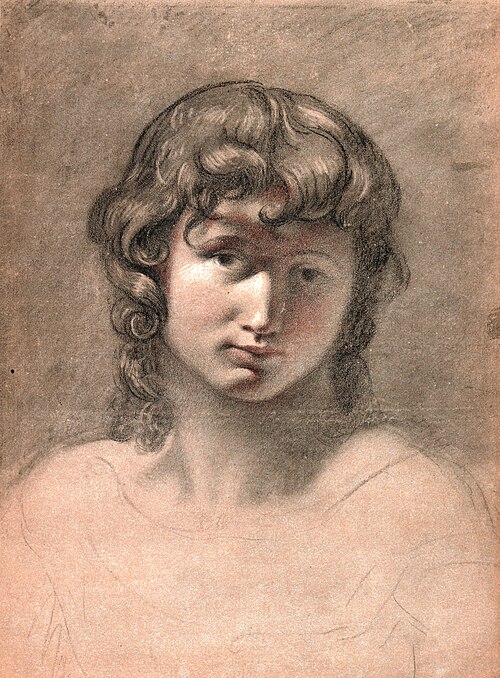
(Johann Heinrich Wilhelm Tischbein)
Wolfgang von Oettingen, Goethe und Tischbein, Weimar 1910
The Note about the Fan
In the Weimar archives, inside a bundle of papers no one had ever read with attention, Zapperi found a note. Costanza had written it — or rather, had probably dictated it to a scribe, as was customary for women of the common people unaccustomed to the pen. It was in Italian. It read:
«Carissimo amico, ieri sera mi fu dato un ventaglio alla moda; poi mi fu ritolto, desidero da voi trovarmene subito un altro per far vedere a questo, che si trovano altri ventagli, e forse più bello di quello. Scusate l’ardire e resto, lo Costanza Releier.» [“Dearest friend, last evening I was given a fashionable fan; then it was taken back from me. I wish you to find me another at once, to show this one that other fans are to be had, and perhaps finer than that one. Forgive my boldness, and I remain, Costanza Releier.”]
A request for a fan. Innocuous, apparently. But Zapperi reads it as an indirect proposal of betrothal: according to the social codes of eighteenth-century Rome, the gift of a fan functioned as a pledge, a signal of intent, a way of asking whether the bond had a future.
Is the reading legitimate? Yes. Is it demonstrable? No. The reviewer Mauro Ponzi puts it with surgical precision: the document is authentic, the interpretation conjectural. There is no explicit evidence either of a physical relationship or of a formal promise. What remains is a tension — real, documented, unresolved.
That Damned Second Pillow
And this is where Tischbein enters the scene.
Not the Tischbein of the great portrait — Goethe in the Roman Campagna, the image everyone knows, the poet reclining among ruins in a broad-brimmed hat, the noble profile, the golden light. No. The other Tischbein. The private one, ironic, impudent among friends.
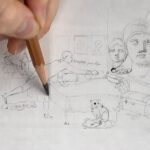
The drawing is entitled Das verfluchte zweite Kissen — that damned second pillow. It is not a work meant for the public. It is a quip, an inside joke among men who know each other well, who have shared months of daily life, taverns, Roman nights. Tischbein draws and laughs. Goethe, in all likelihood, takes the blow.
What does it depict? A bed. One pillow too many. The physical obstacle — real or metaphorical — between desire and its fulfilment. Zapperi reads it as an ironic allusion to the unconsummated embrace with Costanza: the drawing of one friend teasing another over a lost opportunity, a missed moment, that particular combination of shyness, social convention and a young woman who would not be persuaded — or who set conditions Goethe was not prepared to accept.
It is friendly satire, never vulgar. It is the idiom of people who live elbow to elbow and can permit themselves anything within the four walls of a tavern. It does not name Costanza. It might refer to a generic situation. But the context, the chronological coincidence, the commissioned portrait, the preserved note — everything points in the same direction.
What the Italian Journey Does Not Tell
Goethe returned to Weimar in June 1788. In the months that followed he began writing the Roman Elegies — twenty poems in elegiac distichs, the form of Tibullus and Propertius, in which a poet in Rome loves a woman of the people. The name he gives her is Faustina.
Who Faustina really was is one of the most debated questions in Goethe philology. Zapperi definitively resolves a historical misunderstanding: the widowed innkeeper whom some nineteenth-century scholars had identified as Faustina had died long before Goethe’s arrival in Rome. That trail was false. But a second note found in the Weimar archives — written in ungrammatical Italian by an unidentified woman of the people — reads:
«io vorei sapere perche sete ieti a sera un dato a cosi via senza dirmi niente io io credo che vi siete piliati colata ma io spero di no io sono tutta per lei amatima si potete come io amo a lei…» [“I would like to know why you went away like that last evening without saying anything to me I I think you have taken offence but I hope not I am all yours love me if you can as I love you…”]
A quarrel. A misunderstanding. A woman waiting for an answer who cannot even write properly, because what she feels is larger than the words at her command. Zapperi calls her Faustina for convenience. He shows that Goethe had a real, non-mercenary affair with her — a strong passion, kept secret not only out of personal discretion but because the Roman ecclesiastical authorities of the time could compel lovers to marry, on pain of imprisonment.
Of all this, the Italian Journey bears no trace.
The Book and the Life
Goethe returned to the Italian Journey decades later, reworking it several times. The third and final part dates from 1829 — more than forty years after the events. By then Rome had become aesthetic education, intellectual rebirth, a Platonic itinerary among ruins and museums. The taverns of Via dei Condotti, Costanza’s note, Tischbein’s drawing: filed away. Sublimated. Transformed into something else.
It is the principle that gives his autobiography its title — Dichtung und Wahrheit, Poetry and Truth. Life as raw material that literature shapes, selects, rearranges. It does not falsify: it chooses. It does not lie: it keeps silent.
But archives do not keep silent.
And Tischbein, with his damned second pillow, had left between the lines what the Journey would pass over in silence.
Sources:
Roberto Zapperi, Das Inkognito. Goethes ganz andere Existenz in Rom, Beck, München, 1999
Mauro Ponzi, review of Roberto Zapperi, Das Inkognito. Goethes ganz andere Existenz in Rom, in «Studi Germanici», n.s. 37 (1999), 3, pp. 539-542
J.W. Goethe, Roman Elegies
J.W. Goethe, Italian Journey, trans. Robert R. Heitner, ed. Thomas P. Saine and Jeffrey L. Sammons, Suhrkamp, New York 1989